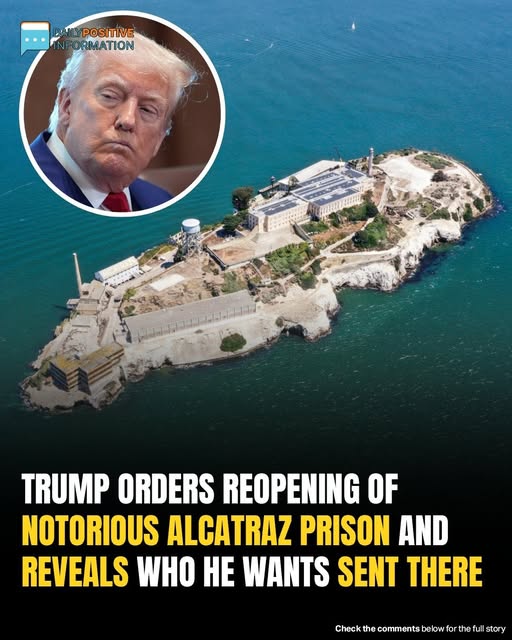
In recent public discussions about crime, justice, and the future of correctional facilities in the United States, Alcatraz Island has once again entered the national conversation. Globally recognized as a former high-security prison and now a major historical landmark, Alcatraz has long symbolized isolation, strict incarceration, and the evolution of the American justice system. Recent statements by former President Donald Trump have renewed attention on the island, suggesting the possibility of reimagining its role in modern corrections. This discussion offers an opportunity to examine Alcatraz in historical, logistical, legal, and social contexts, providing a neutral overview suitable for general audiences.
Alcatraz Island, located approximately 1.25 miles from the San Francisco shoreline, has a long history predating its role as a federal prison. In the mid-19th century, it was developed as a military fortification to protect San Francisco Bay during a period of national expansion. Its natural isolation, surrounded by cold and fast-moving waters, made it strategically valuable. By the early 20th century, the island transitioned into a detention facility for military prisoners, a role that emphasized the difficulty of escape due to its remoteness. This foundation paved the way for its transformation into a federal penitentiary.
In 1934, amid rising concerns over organized crime, Alcatraz was officially designated a federal prison. It was intended to house inmates considered difficult to manage or prone to escape attempts at other facilities. The prison quickly became notorious for its strict rules, austere living conditions, and the high-profile inmates it held. Life inside Alcatraz, while disciplined, was not necessarily harsher than that in other prisons of the era. Inmates had individual cells, regular meals, and basic necessities, but the combination of rigorous routines, limited privileges, and the psychological weight of near-impossible escape set the institution apart. Famous inmates such as Al Capone, George “Machine Gun” Kelly, and Robert Stroud, the “Birdman of Alcatraz,” contributed to its enduring reputation.
Despite its reputation for security, Alcatraz was not a long-term solution for the federal prison system. By the early 1960s, the facility faced rising operational challenges. Operating a prison on an island required transporting all supplies, including food, fuel, and water, by boat, making it nearly three times as expensive as comparable mainland prisons. The infrastructure was aging, and modernizing it would have required substantial investment. At the same time, newer mainland facilities could provide high security more efficiently. The prison’s closure in 1963 reflected broader shifts in correctional philosophy, emphasizing centralized facilities, cost efficiency, and evolving standards for inmate management.
Following its closure, Alcatraz entered a new chapter as a historic landmark. In 1972, it became part of the Golden Gate National Recreation Area and opened to the public. Today, it attracts millions of visitors annually, who explore the cellhouse, learn about prison life, and encounter the island’s cultural significance, including the 1969–1971 occupation by Native American activists highlighting indigenous rights. Preservation laws protect the island’s structures, ensuring that it remains a site for education and tourism. Any proposal to repurpose Alcatraz as a correctional facility would need to consider these protections carefully.
Recently, former President Donald Trump suggested reopening Alcatraz as a maximum-security facility. Public statements referenced renovating existing structures and potentially expanding the site to house individuals convicted of serious offenses, including certain non-citizens involved in criminal activity. The proposal was framed as a symbolic gesture emphasizing accountability, public safety, and law enforcement. However, these statements did not include detailed timelines, budgets, or legislative frameworks and were primarily presented as proposals for exploration by federal agencies.