In a coordinated military operation involving the United States and Israel, forces launched precision airstrikes and missile attacks against strategic targets throughout Iran. The offensive — described in media reports as Operation Epic Fury — was designed to dismantle critical elements of Tehran’s military and defense infrastructure and to target high-ranking leaders within the Iranian establishment. Central among these targets was Ayatollah Khamenei himself, the supreme leader who wielded ultimate authority over Iran’s political, military, and religious apparatus.
Satellite imagery and battlefield reports quickly showed that the leader’s compound in central Tehran — a heavily fortified complex that had long served as both residence and command center — was struck with overwhelming force. Buildings that for decades symbolized the enduring grip of Khamenei’s regime were reduced to smoking rubble, broken stone, and twisted metal. The devastation was unlike any seen before at such a seat of power in modern Iranian history.
Within hours of the assault, officials from the Israeli government publicly stated that credible intelligence suggested the strike had hit its intended target: the supreme leader himself. As smoke still drifted over the capital, Israeli Prime Minister Benjamin Netanyahu announced that there were “many signs” indicating that Khamenei was “no longer alive,” a statement that sent shockwaves around the globe.
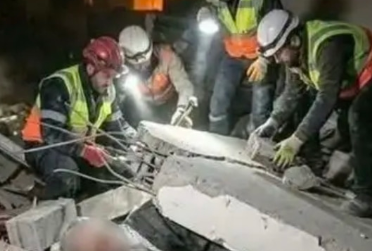
Shortly thereafter, reports emerged from Israeli sources that rescue and recovery teams had located what they identified as Khamenei’s body beneath the rubble of his compound. Imagery and documentation were reportedly shown to American and Israeli leaders, reinforcing their claim that the supreme leader had perished in the attack. These details — including the recovery of his remains from the ruins — became the focal point of media coverage and international analysis.
Global reactions were intense and sharply divided. In Tehran and across Iran, state media confirmed the death of the supreme leader, while government officials declared a formal period of national mourning. Islamic clerics and political figures described Khamenei’s death as martyrdom, framing it as a moment that would galvanize the Iranian people and stiffen resistance to what they labeled foreign aggression.
Outside Iran, some world leaders expressed alarm at the potential for escalation. Many warned that the removal of such a pivotal figure — particularly in such destructive circumstances — could destabilize the region further. Analysts cautioned that even if Khamenei’s body had been recovered from the rubble, the real challenge lay in what came next: a leadership vacuum in Tehran, possible retaliation, and uncertainty about who could succeed a man who had shaped Iran’s national policy for nearly four decades.
At the same time, commentators and critics of Khamenei’s leadership cited his long record of repression, controversial foreign policies, and confrontations with neighboring states, arguing that his death under such conditions could mark a turning point in Middle Eastern geopolitics.
Whether his recovery from the rubble will be verified with incontrovertible evidence or contested in the coming days remains uncertain. What is already clear, however, is that this moment — defined by the collapse of his compound and the claimed retrieval of his body — will be remembered as a dramatic and potentially transformative event in the history of the region.