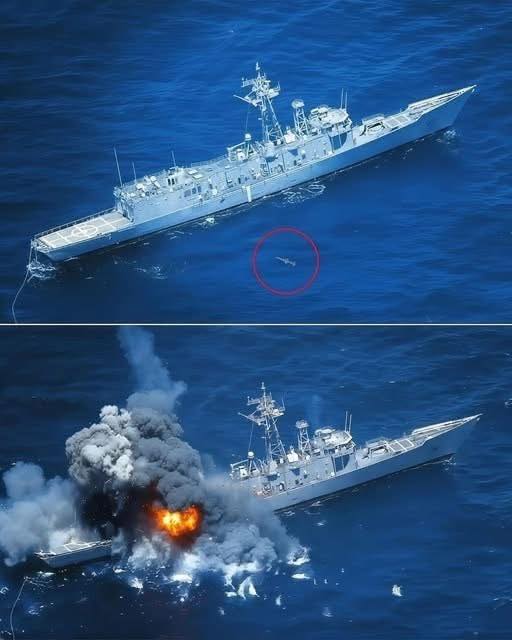
The former USS Rodney M. Davis (FFG-60), once an active guided-missile frigate of the United States Navy, met its final fate not in combat but in a carefully planned and controlled SINKEX (sinking exercise). After decades of honorable service, the ship was deliberately sunk following a successful strike by an AGM-84 Harpoon anti-ship missile. While dramatic in appearance, the event represented a routine yet important part of naval training and weapons evaluation rather than a battlefield loss.
Commissioned in 1982, USS Rodney M. Davis belonged to the Oliver Hazard Perry-class of frigates, a workhorse class designed during the height of the Cold War. These ships were built primarily to protect carrier strike groups and merchant convoys from submarine threats, while also providing surface and limited air defense capabilities. With a length of over 450 feet and equipped with advanced sonar and missile systems for its time, the frigate played a versatile role in U.S. naval operations for many years.
The ship was named in honor of Sergeant Rodney Maxwell Davis, a Marine Corps Medal of Honor recipient who sacrificed his life during the Vietnam War. Carrying his name, the vessel served with distinction across multiple theaters, participating in patrol missions, multinational exercises, maritime interception operations, and security deployments. Over its service life, the frigate and its crews contributed to presence operations in the Pacific, the Middle East, and beyond.
Like many Perry-class ships, USS Rodney M. Davis eventually approached the end of its operational lifespan as newer, more advanced platforms entered the fleet. Rather than simply being scrapped, the Navy selected the vessel for use in a SINKEX — a live-fire training exercise that allows the military to test weapons systems against real hulls under controlled conditions. These exercises provide rare real-world data that cannot be fully replicated through simulation alone.
Before the sinking exercise took place, the ship underwent an extensive environmental and safety preparation process. Hazardous materials such as fuels, oils, and certain chemicals were carefully removed in accordance with environmental protection standards. Sensitive military equipment and classified systems were also stripped from the vessel. This preparation ensures that the sinking poses minimal environmental risk while preserving operational security.
When the day of the exercise arrived, the AGM-84 Harpoon anti-ship missile was launched as planned. The Harpoon, a long-standing staple of U.S. and allied naval forces, is designed to skim low over the water and strike enemy ships with precision. During the exercise, the missile successfully impacted the target, allowing analysts and weapons specialists to observe the effects in real time.
Data collected from SINKEX events like this is considered extremely valuable. Engineers and military planners study how ships absorb damage, how quickly flooding progresses, and how modern weapons perform against real naval structures. These insights help refine future ship designs, improve damage control doctrine, and validate missile effectiveness.
For many former crew members and naval veterans, however, the sinking carried an emotional weight. Ships often become symbols of shared service, long deployments, and personal sacrifice. Watching a vessel with decades of history slip beneath the waves can be bittersweet, even when the purpose is understood and respected.
Ultimately, the controlled sinking of USS Rodney M. Davis marked the closing chapter of a ship that served faithfully through a significant period of modern naval history. Rather than fading quietly into retirement, the frigate’s final mission contributed directly to naval readiness, weapons validation, and the continued evolution of maritime warfare capabilities — a fitting final service for a vessel that spent its life supporting the fleet.