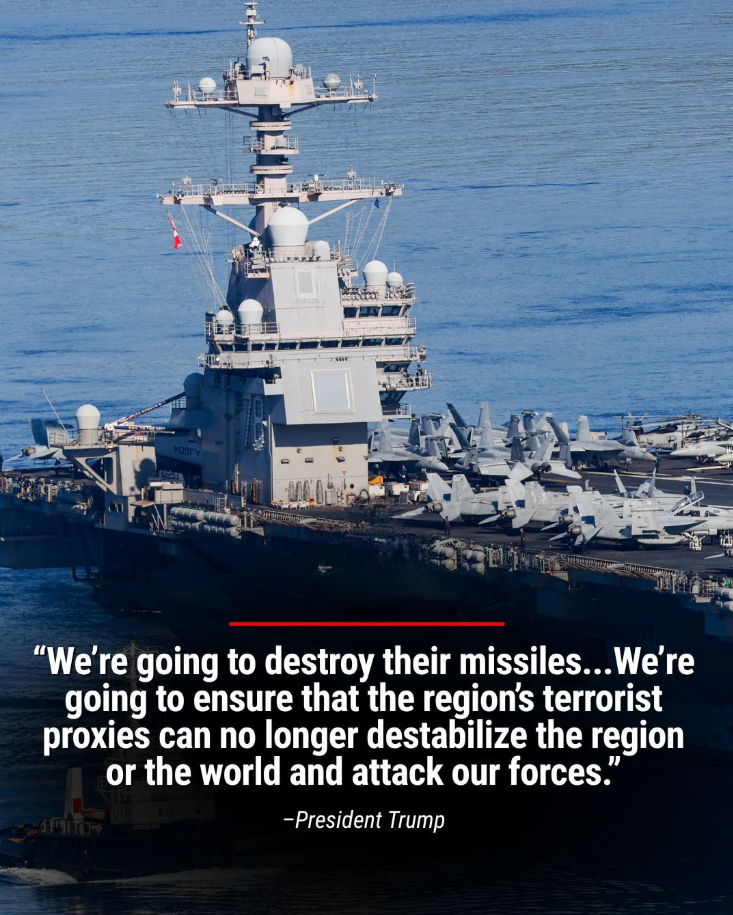
President Donald Trump confirmed on Saturday that the United States has begun what he described as “major combat operations in Iran,” a move that immediately heightened tensions across the Middle East and drew intense global attention. In a statement addressing the unfolding situation, Trump said the mission is intended to defend Americans and eliminate what he called imminent threats posed by the Iranian regime. The announcement signals a significant escalation in the already fragile relationship between Washington and Tehran and raises serious questions about the potential for a wider regional conflict.
According to the president, the decision to launch combat operations came after intelligence assessments indicated that threats against U.S. personnel, interests, and allies in the region were growing rapidly. Trump characterized the Iranian leadership as “a vicious group of very hard, terrible people,” arguing that decisive action was necessary to prevent attacks that could endanger American lives. He emphasized that the objective of the operation is not war for its own sake but rather the protection of U.S. citizens and the neutralization of immediate dangers.
Although the administration has not yet released full operational details, defense officials suggested that the campaign includes targeted strikes against facilities believed to be connected to military planning or weapons development. Early reports indicate that U.S. forces, including aircraft and naval assets stationed in the region, have been mobilized as part of the operation. Military planners are reportedly focusing on strategic targets while attempting to minimize civilian casualties and broader infrastructure damage.
The announcement quickly sparked reactions from political leaders, military analysts, and international observers. Supporters of the president argue that confronting threats before they materialize is a necessary component of national defense. They contend that Iran has long been accused of supporting armed groups and destabilizing activities throughout the Middle East, and that strong action may deter further aggression.
Critics, however, warn that initiating large-scale military operations against Iran carries enormous risks. Iran is a major regional power with significant military capabilities and influence across multiple countries. Analysts caution that even limited strikes could trigger retaliation against U.S. forces, allies, or commercial shipping routes in the region. Some fear that the situation could spiral into a prolonged and unpredictable conflict if diplomatic channels fail to contain the escalation.
Members of Congress from both parties have begun calling for briefings from the administration to better understand the scope of the operation and the intelligence behind it. Several lawmakers emphasized the importance of transparency and oversight, noting that decisions involving military force carry profound consequences not only for American troops but also for global stability.
International reactions have been mixed and cautious. Some allied governments expressed concern about the potential for wider instability, urging both sides to avoid further escalation and to pursue diplomatic solutions wherever possible. Others acknowledged the United States’ right to defend its citizens but stressed the importance of clear communication and restraint.
Within the United States, the announcement has also ignited a broader debate about the country’s role in the Middle East and the balance between military action and diplomacy. After decades of conflicts in the region, many Americans remain wary of new military engagements, particularly ones that could expand into a larger war.
Despite the uncertainty surrounding the operation, Trump maintained a firm tone, stating that protecting Americans remains his administration’s top priority. He insisted that the United States will respond forcefully to any threat against its people or interests and suggested that failing to act could invite greater danger in the future.
As events continue to unfold, military officials and diplomats alike are closely monitoring the situation. The coming days will likely determine whether the operation remains limited in scope or develops into a broader confrontation. For now, the world is watching carefully as one of the most sensitive geopolitical flashpoints faces yet another moment of heightened tension.