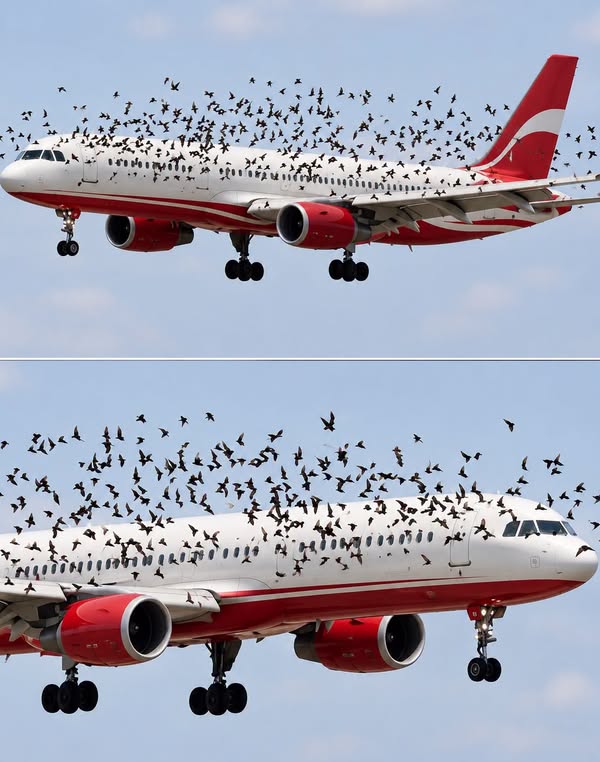
Captain Jason Vance expected nothing unusual when he took his seat in the cockpit that morning.
The flight looked like any other routine assignment. The weather was calm. Visibility was good. The aircraft had passed its expected checks without giving the crew any reason for concern. For Jason, it was the kind of journey that usually disappeared into the long list of ordinary flights pilots complete throughout their careers.
There were no threatening clouds on the horizon. There was no serious turbulence. There were no mechanical warnings.
Nothing suggested that everyone aboard the aircraft would soon be fighting to survive.
At first, the only unusual detail was a small group ofbirdsflying in the distance.
Jason noticed them. He did not immediately become alarmed.Birdsoccasionally appeared near aircraft after takeoff. Isolated encounters were not necessarily dangerous. He continued watching his instruments. He maintained the planned course. He allowed the flight to settle into its normal rhythm.
Behind him, passengers were relaxing into their seats.
Some were looking out the windows. Others were settling in for the journey. A few had already begun reading, sleeping, or preparing for the hours ahead.
Nobody knew that the peaceful beginning of the flight was about to disappear.
Within minutes, the situation changed dramatically.
The few birds Jason had noticed earlier were no longer alone.
What initially looked like an ordinary group of birds rapidly developed into an enormous flock moving directly around the aircraft.
Jason watched as the birds filled the space surrounding the plane.
The flock moved in a dense and chaotic formation. The movement made it difficult for Jason to predict where the birds would go next.
The sounds traveled through the fuselage. Passengers who had no idea what was happening outside were startled. Some immediately turned toward the windows. Others looked at the flight attendants for an explanation.
Jason tightened his grip on the controls.
Abirdstrike was something pilots were trained to take seriously, particularly when large numbers of birds were involved. This event involved a continuous stream of birds.
Jason attempted to alter the aircraft’s course.
The peaceful cockpit became intensely focused and filled with activity.
Jason’s attention moved rapidly between the aircraft’s instruments and the world outside the windshield.
Some birds struck the front of the aircraft. Others passed beneath the wings. More collided with the fuselage.
Passengers could hear repeated blows against the aircraft’s exterior. Fear spread throughout the cabin.
Jason knew that the aircraft could withstand certain bird strikes. The sheer number of impacts created a rapidly escalating threat.
Then the situation became dramatically worse.
A bird was drawn toward one of the engines.
Jason saw it happen. There was almost no time to react.
Almost immediately, the aircraft shook violently.
The routine flight had become an emergency.
An engine failure is a serious event under any circumstances.
An engine ingesting a large bird can cause substantial damage. The situation becomes even more challenging when the aircraft is still relatively close to its departure point and surrounded by a massive flock.
Jason focused on keeping the aircraft stable.
The plane was still flying. It no longer felt normal.
Smoke and the smell of damaged machinery began moving through the aircraft. Passengers could sense that something serious had happened.
Others grabbed their seats or held onto the people beside them.
The flight crew worked to maintain calm while Jason concentrated on the controls.
He knew there was a critical decision ahead.
He needed to decide whether he could turn back.
He needed to decide whether he could reach the main airport.
He needed to decide whether attempting either option would put everyone aboard at even greater risk.
He needed somewhere long and open enough to give the damaged aircraft a chance to land.
The main airport was no longer an easy option.
Reaching it would require maintaining sufficient altitude and control for the remainder of the journey. Jason could not be certain the aircraft would remain stable long enough to make it.
There were rough patches of ground. There were isolated areas. There was a large, desolate lake.
A landing near the water could be catastrophic.
It was narrow and appeared almost abandoned. Compared with the surrounding terrain, it offered the best chance available.
The aircraft descended toward the remote strip.
The damaged engine had changed the aircraft’s behavior. He had to compensate while maintaining as much control as possible.
The runway—or what remained usable of it—was approaching rapidly.
For a moment, everything seemed to slow down.
The plane bounced violently before coming down again.
Its wheels and body began sliding across dirt and uneven terrain.
Inside the cabin, passengers were thrown against their restraints.
Loose objects shifted and flew through the interior.
Jason fought to keep the aircraft moving in a controlled direction.
The aircraft was sliding toward the lake.
If it left the strip and entered the water at high speed, the consequences could be devastating.
Jason held the aircraft as firmly as he could.
Dirt and dust rose around the fuselage, partially blocking the view.
Then, gradually, the aircraft began losing momentum.
It had come to rest without reaching the lake.
For several seconds, nobody seemed to know what to do.
Jason soon realized the strangebirdencounter was not over.
Jason expected the flock to disappear once the aircraft was safely on the ground.
The plane was no longer moving through the sky.
The immediate danger seemed to have ended.
Thousands—or at least what appeared to be an enormous number—remained in the air above the damaged aircraft.
Their calls echoed across the isolated landscape.
Something about their behavior bothered him.
They were not simply flying through the area.
They repeatedly returned to one particular section.
The birds seemed to be concentrating on that part of the plane.
At that moment, he began to wonder whether the bird strikes had been connected to something inside the aircraft.
During the flight, the flock had appeared completely chaotic.
From the cockpit, Jason initially thought the birds were simply behaving unpredictably.
Now, standing safely on the ground, he could see something he had missed in the air.
The flock was not equally interested in every part of the aircraft.
What could possibly be inside the cargo hold that would cause such a massive flock to follow an aircraft?
Jason knew the official cargo manifest should have contained nothing unusual.
The birds were behaving as though they knew exactly what they were looking for.
His concern about the damaged engine was now joined by another question.
After making sure the passengers were no longer in immediate danger, Jason cautiously left the aircraft.
Pieces of damaged material were scattered across the ground.
Long marks from theemergency landingstretched across the dirt behind the aircraft.
The lake sat nearby, adding to the isolation of the scene.
Jason watched the birds as he approached the cargo hold.
They seemed interested in only one thing.
There were containers and freight arranged in what looked like a normal shipment.
Nothing immediately explained why an enormous flock of birds had chased the aircraft.
Jason began examining the cargo more carefully.
Part of the cargo arrangement did not look right.
The visible freight appeared to have been positioned in a way that concealed a section behind it.
It was not simply an ordinary arrangement of boxes.
Someone had deliberately created a hidden space.
The compartment was concealed behind the legitimate-looking cargo, making it difficult to notice during a casual inspection.
Inside the concealed compartment were dozens of exotic bird eggs.
They had apparently been taken from their natural environment and hidden inside the aircraft for illegal trafficking.
The flock had not been following the aircraft randomly.
What Jason initially interpreted as a bizarre and dangerous attack now appeared to have a completely different explanation.
The birds had been responding to the disappearance of their young.
The hidden cargo had transformed an ordinary flight into something far more disturbing.
Someone had attempted to transport the eggs secretly, relying on the ordinary-looking freight to conceal them.
Jason thought back to the moments in the sky.
The way the birds continued following the aircraft.
The way they refused to scatter after the emergency landing.
The birds were not simply attacking the aircraft.
They were attempting to remain close to the stolen eggs.
Their behavior had been driven by an instinctive response to the removal of their offspring.
The discovery did not make theemergencyless frightening.
The aircraft had still suffered serious damage.
Passengers had endured a terrifying emergency landing.
The discovery gave meaning to what had previously seemed inexplicable.
The eggs had apparently been concealed behind legitimate-looking freight so that they could pass through the journey without attracting attention.
If the flight had continued normally, the hidden compartment might never have been discovered.
The aircraft could have reached its destination.
The eggs could have disappeared into an illegal trafficking network.
The flock’s persistent pursuit changed everything.
The birds created an emergency that forced the aircraft to land.
That emergency brought Jason’s attention to the cargo.
What had initially appeared to be an inexplicable aviation disaster had unexpectedly exposed something much more serious.
Standing beside the open cargo hold, Jason could not help but think about the extraordinary sequence of events.
One of them had even been pulled into the engine.
After the emergency landing, they still refused to leave.
Their behavior had seemed irrational from the cockpit.
Now it appeared painfully understandable.
They were trying to stay close to what had been taken from them.
Across the animal kingdom, parental instincts can be extraordinarily powerful.
Animals do not need human language to respond when their offspring are threatened.
They may defend nests, search for missing young, warn others of danger, or return repeatedly to places where their offspring were last seen.
In this story, thebirds’ behavior appeared to reflect that same instinct.
The aircraft was enormous compared with any individual bird.
Their determination seemed stronger than their fear.
That determination ultimately helped reveal what had been hidden inside the plane.
When Jason began the flight, he had expected another routine assignment.
He expected to complete the journey and move on to the next flight.
He experienced one of the most frightening emergencies imaginable.
A massive flock suddenly surrounded the aircraft.
Jason had to search for an emergency landing site with very little time to spare.
He brought the aircraft down on a remote strip, narrowly avoiding the lake.
They remained above the aircraft until Jason discovered what they had been following.
The flock had not been acting without purpose.
It had been responding to something that had been taken from its environment.
The aircraft had unknowingly become the center of a desperate pursuit.
What looked like aggression was an instinctive attempt to remain close to their offspring.
What looked like a catastrophic accident ultimately revealed a hidden crime.
The strange connection between the flock and the aircraft had been there from the beginning.
Jason simply could not see it until the plane was safely on the ground.
For the passengers aboard that aircraft, the journey would never be remembered as an ordinary flight.
They would remember the strange sounds against the fuselage.
They would remember the terrifying descent and the violent landing.
Most of all, they would remember what happened afterward.
They would remember looking into the sky and seeing the flock still circling above them.
They would remember wondering why the birds refused to leave.
Eventually, they would learn the extraordinary reason.
Hidden inside the cargo hold were dozens of exotic bird eggs connected to an illegal trafficking operation.
The flock’s relentless pursuit had unintentionally exposed what someone had tried to conceal.
What began as a peaceful journey had become a life-threateningemergency, an unexpected mystery, and finally a discovery that changed the entire meaning of the flight.
Captain Jason Vance had started the day expecting nothing more than another routine assignment. He found himself at the center of a story in which a flock of birds, anemergency landing, and a hidden cargo compartment were connected in a way no one aboard could have imagined.
The birds everyone initially feared had not been chasing the aircraft out of aggression. They had been following what had been taken from them. Their determination ultimately helped bring a hidden crime into the light.
The cockpit of Flight 418 transformed into a crucible of high-voltage adrenaline. Master caution alarms chimed rhythmically, casting an amber glow across Captain Jason Vance’s face. Beside him, First Officer Marcus Hayes was already executing emergency checklists with practiced precision. His voice remained tight and steady as he radioed Air Traffic Control.
“Mayday, Mayday, Mayday! Flight 418 experiencing dual bird strikes, engine number one flameout, severe thrust loss on engine two! Requesting immediate emergency vector to the nearest runway!”
Outside, the situation defied explanation. Standard avian behavior dictates that flocks disperse when confronted by the roaring thrust of jet engines. This massive cloud of starlings seemed bound by an unnatural, unified impulse. The density of the flock appeared to thicken, weaving around the wings like a living storm cloud. Every shudder of the aircraft sent shockwaves through the cabin, where 142 passengers gripped their armrests, listening to the strained, grinding roar of the remaining engine.
“Jason, thrust on engine two is decaying!” Marcus shouted over the din of the warning horns. “Exhaust gas temperature is spiking into the red line! We’re losing altitude!”
Jason felt the heavy, sluggish resistance in the control column. The aircraft was sinking toward the sprawling, dense forest reserve that bordered the metropolitan area. Turning back to the primary airport was impossible. They lacked the altitude and power to clear the surrounding ridgeline.
“We aren’t going back,” Jason declared, his voice dropping into a razor-sharp register born of twenty-two years of flight experience. “Look straight ahead. The emergency relief strip at Oakridge Airfield. It’s decommissioned, but the tarmac is long enough.”
“Oakridge?” Marcus’s eyes widened. “It’s unlit, short on radar coverage, and nestled in a valley! We’re descending through heavybirdactivity!”
“It’s our only runway,” Jason said firmly. “Gear up for a high-speed glide approach. We keep the speed up so we don’t stall out when the second engine goes.”
As Jason banked the heavy jet into a steep glide, the second engine gave a sickening metallic screech and went dark. A heavy silence enveloped the cockpit, broken only by the rushing wind outside and the incessant thud-thud of birds slamming against the reinforced nose cone.
In the cabin, Senior Flight Attendant Elena Vance—Jason’s wife of fifteen years—stood in the middle aisle. Though her heart pounded violently against her ribs, her demeanor remained an anchor of total calm for the terrified passengers. She checked seatbelts, reassured weeping mothers, and commanded the cabin with authoritative grace.
“Brace positions! Heads down, stay low!” Elena’s voice echoed clearly over the intercom, cutting through the panic.
She caught her breath for a brief second, looking out the tiny window at the trailing cloud of birds casting a dark shadow over the wingtips. She knew her husband was at the controls. In fifteen years of marriage, she had seen him navigate terrifying winter storms and severe turbulence. She closed her eyes for a split second, trusting entirely in the man sitting in the captain’s chair.
Up front, Jason was fighting the physics of a gliding airliner. Without engine thrust, the hydraulic pressure was dropping, making the control wheel feel as heavy as concrete. The windshield was obscured by fractures and smudges from repeated impacts, obscuring their line of sight.
“One thousand feet!” Marcus called out, his eyes glued to the altimeter. “Airspeed 180 knots! We’re coming in fast and hot!”
“Deploying partial flaps!” Jason grunted, pulling back on the yoke with every ounce of physical strength he possessed. “I need visual on the strip, Marcus! Clear my window!”
Marcus grabbed theemergencyhand-wipers, cycling them frantically. Through a narrow gap in the smeared glass, the dark, cracked asphalt of Oakridge Airfield emerged through the treeline like a needle in a haystack.
The aircraft swept over the perimeter fence of the abandoned airfield with barely fifty feet of clearance. The flock ofbirds, as if finally breaking their hypnotic formation, scattered in a wild burst against the tree canopy as the jet broke through the lowest thermal layer.
“No thrust reversers! Brakes only!” Jason shouted. “Hold on!”
The main gear slammed onto the cracked asphalt with a violent jolt. Tire smoke billowed into the afternoon sky as Jason slammed his feet onto the mechanical brake pedals. The aircraft shuddered violently, skidding across patches of overgrown weeds and loose gravel along the ancient runway.
The end of the runway was approaching fast—a thick wall of pine trees standing like giant sentinels at the edge of the tarmac.
Jason applied asymmetric braking, deliberately sliding the tail of the plane to shed momentum. The jet groaned, swinging sideways in a controlled drift before finally coming to a complete stop mere twenty yards from the tree line.
For three seconds, absolute silence reigned in the cockpit and the cabin alike.
Then, the emergency power systems clicked on, illuminating the cabin with soft emergency lighting.
“Evacuate! Evacuate!” Jason ordered over the PA system.
Flight attendants opened the doors, deploying the inflatable slides. Within three minutes, all 142 passengers and six crew members were standing safely on the firm earth of the overgrown airfield, hugging one another, crying, and gazing in disbelief at the silent, battle-scarred aircraft.
Emergency vehicles from three surrounding counties arrived within twenty minutes, their red and blue lights painting the quiet valley in vibrant hues. Paramedics moved through the crowd. Aside from minor bruises and shock, not a single life had been lost.
Jason sat on the bumper of a responding fire engine, his captain’s hat resting on his knee. His hands, which had held 70,000 pounds of metal out of the sky through sheer willpower, were now trembling uncontrollably.
Elena walked over, wrapping a warm emergency blanket around his shoulders. She sat beside him, gently taking his shaking hand in hers.
As the adrenaline finally leaked out of his system, the weight of what had almost happened crashed down on Jason. He looked at the long line of passengers sitting safely on the grass—children holding their parents, young couples holding hands, elderly passengers smiling through tears of relief.
A lone journalist who had rushed to the scene with a local news crew approached quietly, holding a microphone.
“Captain Vance,” the reporter whispered respectfully. “You just pulled off an absolute miracle. You brought a dead-engine aircraft down on an abandoned runway surrounded by thousands of birds without a single casualty. How do you feel?”
Jason looked up. Tears began to stream silently down his weathered cheeks, catching the red flash of the emergency lights. He tried to speak, but his throat tightened.
“I… I wasn’t thinking about the plane,” Jason choked out, his voice breaking as he looked over at Elena, then back at the crowd of survivors. “When those engines failed, all I saw were 142 families waiting to go home. I promised myself when I took this uniform years ago that everyone who boarded my plane would walk off it alive.”
He covered his face with his hands, letting the tears fall freely—out of the overwhelming, profound relief of a man who had carried over a hundred lives on his shoulders and brought them safely back to earth.
The crowd of passengers, noticing the captain sitting on the back of the fire truck, slowly rose to their feet. A single applause started near the ambulance, and within seconds, the quiet forest echoed with a thunderous ovation for Captain Jason Vance—the man who had fought the sky and won.