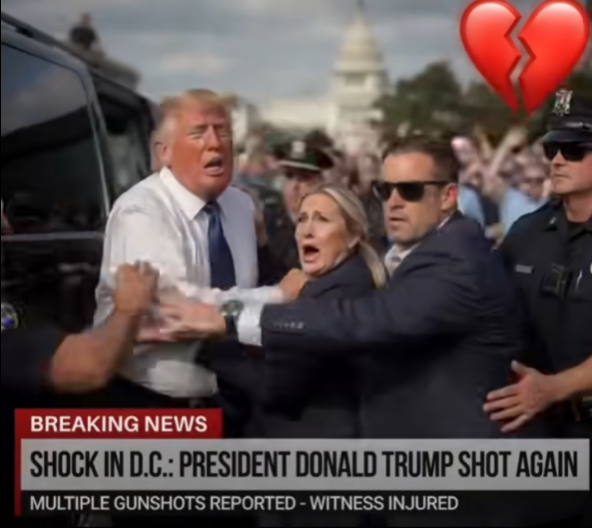
Recent social media activity has been dominated by a wave of alarming posts claiming that former President Donald Trump was involved in a second shooting incident in Washington, D.C. The reports spread rapidly across multiple platforms, attracting thousands of shares, comments, and reactions within a very short period. Many of the posts were written using urgent language designed to provoke emotional responses, causing confusion among users who encountered the claims before any verification had taken place.
As often happens during high-profile news events, the story gained momentum long before any credible evidence emerged. Social media users began reposting screenshots, videos, and dramatic headlines, with some accounts presenting the claims as confirmed facts despite the absence of official information. Within hours, the rumor had reached millions of people, demonstrating how quickly unverified information can travel in today’s digital environment.
However, closer examination revealed a very different reality.
Neither the United States Secret Service nor any federal law enforcement agency issued alerts, warnings, or statements indicating that such an incident had occurred. Likewise, major national and international news organizations—entities that continuously monitor developments involving former presidents and other high-profile political figures—reported no evidence supporting the claim.
For many media analysts, this absence of confirmation was one of the strongest indicators that the story lacked credibility.
In situations involving prominent political figures, genuine security incidents typically generate immediate responses from multiple sources. Official agencies often release preliminary statements, emergency alerts may be issued, and news organizations quickly deploy reporters to verify details. The complete lack of such activity surrounding the alleged incident raised significant doubts from the very beginning.
Investigations conducted by fact-checkers and media monitoring groups soon identified several potential sources of the misinformation.
Many viral posts appeared to recycle old photographs, video clips, and footage from unrelated events. Some images originated from previous campaign rallies, public appearances, or security incidents that had occurred years earlier. By removing the original context and attaching misleading captions, the creators of the posts were able to make old material appear connected to a current event.
This tactic is increasingly common in the digital age.
Experts who study online misinformation note that recycled content often spreads more successfully than completely fabricated material because the underlying images or videos are genuine. Viewers may recognize the visual content as real without realizing that the accompanying description is false or misleading.
As a result, the emotional impact of the images can override critical thinking.
Many users share content based on immediate reactions rather than taking time to verify its authenticity.
Social media algorithms can unintentionally contribute to this problem.
Platforms frequently prioritize content that generates strong emotional engagement. Posts that provoke fear, outrage, shock, or excitement often receive more visibility because users are more likely to comment, share, and interact with them. Unfortunately, misinformation creators understand this dynamic and frequently design content specifically to exploit these patterns.
By the time professional fact-checkers publish corrections, the original claims may have already reached millions of people.
This creates a significant challenge for journalists and public officials attempting to combat false narratives.
The recent rumors also appear to have been influenced by memories of an actual security incident involving Donald Trump that occurred in 2024.
That event, which took place during a campaign rally in Butler, Pennsylvania, was extensively documented through eyewitness accounts, video recordings, official investigations, and media coverage. The incident resulted in major security reviews and generated worldwide attention.
Because that attack genuinely occurred, some observers suggest that it may have made audiences more susceptible to believing similar claims in the future.
When people are already aware of a previous real event, fabricated stories that resemble it can sometimes appear more believable.
This psychological phenomenon has been observed repeatedly in misinformation campaigns across many different topics.
Political analysts argue that the spread of false reports reflects broader challenges facing modern information systems.
The speed at which information moves today is unprecedented. A single social media post can reach enormous audiences within minutes, often long before traditional verification processes have had time to operate.
Journalistic standards typically require confirmation from multiple independent sources before major claims are reported as fact.
While this process may appear slower, it serves a critical purpose.
Verification helps protect the public from false information, rumors, and manipulation.
Unfortunately, the pace of social media frequently rewards immediacy rather than accuracy.
As a result, emotionally compelling narratives can spread far more quickly than carefully verified reporting.
Media literacy experts emphasize that individuals can take several practical steps to reduce the likelihood of being misled by viral claims.
These include:
Checking whether reputable news organizations are reporting the same story.
Looking for official statements from relevant authorities.
Examining the publication date of images and videos.
Comparing information across multiple independent sources.
Avoiding sharing content before verification has occurred.
Such practices may seem simple, but they can significantly reduce the spread of misinformation.
The incident also highlights the importance of maintaining skepticism toward sensational headlines.
Many misleading posts rely on dramatic language designed to create urgency. Phrases such as “breaking,” “shocking,” “confirmed,” or “share before it’s deleted” are frequently used to encourage immediate reactions while discouraging careful evaluation.
Understanding these techniques can help users recognize potential warning signs before accepting a claim as true.
Ultimately, the false reports surrounding Donald Trump serve as another example of how rapidly misinformation can spread in highly polarized environments. Political topics often generate strong emotional responses, making them particularly vulnerable to manipulation through misleading content.
The episode reinforces a lesson that remains increasingly important in the digital age: speed should never replace accuracy.
As technology continues transforming the way information is distributed, the responsibility to verify facts becomes more important than ever. Reliable journalism, official confirmation, and critical thinking remain essential tools for navigating a world where rumors can travel globally within minutes.
In the end, no credible evidence supported the claim of a second shooting incident involving Donald Trump in Washington, D.C. What remained was not a genuine security emergency, but rather a powerful demonstration of how quickly misinformation can spread when sensational claims are shared before they are verified.
For readers and social media users alike, the event serves as a valuable reminder to pause, verify, and think critically before accepting or sharing extraordinary claims online.