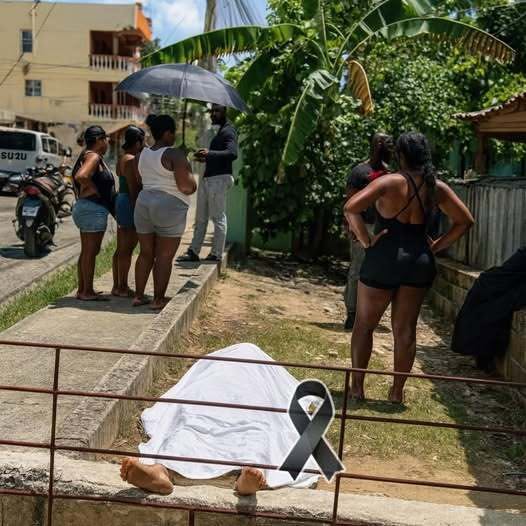
A quiet neighborhood in San Pedro de Macorís has been shaken by the tragic loss of a 17-year-old boy, a moment that has left family members, neighbors, and the wider community struggling to process both grief and uncertainty. In a place where daily life typically moves at a steady, familiar pace, the sudden death of someone so young has disrupted that sense of normalcy, replacing it with questions that, for now, remain unanswered.
The young victim, identified as Antoni David García, was found lifeless on Friday morning in the yard of his home on “T” Street in the Restauración neighborhood. What should have been an ordinary morning quickly turned into a scene of shock and sorrow, as those closest to him were confronted with a reality they could hardly comprehend. According to preliminary reports, he experienced respiratory distress linked to neck constriction. However, authorities have emphasized that the exact circumstances surrounding his death are still unclear and remain under active investigation.
For the people who knew Antoni, the difficulty lies not only in the loss itself, but in the absence of any clear explanation. Neighbors have described the moment the news spread as surreal, with many initially unable to believe what they were hearing. In tight-knit communities like Restauración, where families often know each other well and daily interactions are part of a shared routine, such an event carries a particularly heavy emotional weight.
Relatives, visibly shaken, have expressed their heartbreak while also grappling with confusion. Several have stated that they were unaware of any issues or struggles that might have hinted at something being wrong. This lack of warning has made the situation even more painful, as it raises difficult and deeply personal questions—questions about whether anything might have been missed, and whether something could have been done differently.
Emergency services responded quickly after receiving the alert. A unit from the National Emergency and Security System 9-1-1 arrived at the scene within minutes, bringing with them the urgency and professionalism that such situations demand. Despite their efforts, however, there were no signs of life. Attempts at resuscitation were not successful, and the focus soon shifted from rescue to understanding what had happened.
As the reality of the situation set in, authorities began the careful and methodical process that follows any unexplained death. Officials from the National Institute of Forensic Sciences (INACIF), along with representatives from the Public Prosecutor’s Office and the Central Directorate of Criminal Investigations (DICRIM), arrived to secure the area and begin gathering information. Their presence marked the start of an investigation that will seek to provide answers not only for legal purposes, but also for a grieving family and community.
The body was removed from the scene and transported for an autopsy, a crucial step in determining the precise cause of death. Forensic examinations are often the only way to clarify circumstances that are not immediately visible, especially in cases where initial observations leave room for multiple possibilities. While this process can take time, it remains essential in ensuring that conclusions are based on evidence rather than speculation.
In the meantime, the neighborhood has been left to cope with a mix of emotions—sadness, disbelief, and a lingering sense of unease. Conversations among residents often circle back to the same question: how could something like this happen without anyone noticing? It is a question that, in many cases like this, does not have a simple answer.
Moments like these also highlight the broader challenges communities face when dealing with sudden and unexplained loss. The absence of clear information can create space for rumors and assumptions, which can spread quickly, especially in the age of social media. Local authorities have urged patience, emphasizing the importance of allowing the investigation to proceed without interference or premature conclusions.
At the same time, the human side of the tragedy remains at the forefront. Friends and neighbors have begun to gather in small groups, offering support to one another and to Antoni’s family. In communities like Restauración, solidarity often becomes a source of strength during difficult times. Simple gestures—a visit, a conversation, a shared memory—can help ease the weight of grief, even if only slightly.
For Antoni’s family, the coming days are likely to be filled with both mourning and waiting. Mourning for a life lost far too soon, and waiting for answers that may help them understand what happened. It is a difficult balance, one that requires both emotional resilience and patience with a process that cannot be rushed.
As the investigation continues, officials are expected to release more information once the autopsy results are complete and all relevant evidence has been reviewed. Until then, much of what surrounds the case remains uncertain. What is clear, however, is the impact of the loss—a young life gone, and a community left to grapple with the silence that follows.
In the end, tragedies like this serve as a stark reminder of how fragile life can be, and how quickly circumstances can change. They also underscore the importance of compassion, both for those directly affected and for the broader community trying to make sense of what has occurred.
For now, San Pedro de Macorís mourns. And as investigators work to uncover the facts, a family and a neighborhood wait, holding on to memories while searching for understanding in the midst of loss.