🇮🇷 Dangerous Escalation in the Persian Gulf – A Deep Dive Into the Reported Attacks on U.S. Bases
In early 2026, the already fragile security landscape of the Middle East faced a dramatic and dangerous escalation. Reports began emerging of coordinated attacks targeting United States military bases across the Persian Gulf region, allegedly carried out by Iran. These developments, rapidly spreading through international media and regional sources, triggered widespread concern among governments, military analysts, and civilians alike.
While initial information remains fluid and, in some cases, unconfirmed, the scale and coordination of the reported incidents suggest a significant shift in regional tensions—one that could have far-reaching consequences both locally and globally.
A Night of Explosions Across the Gulf
According to multiple reports, Iranian state television announced the launch of military operations targeting U.S. bases in the Gulf. Shortly after, news agencies began reporting explosions and defensive responses across several countries hosting American military installations.
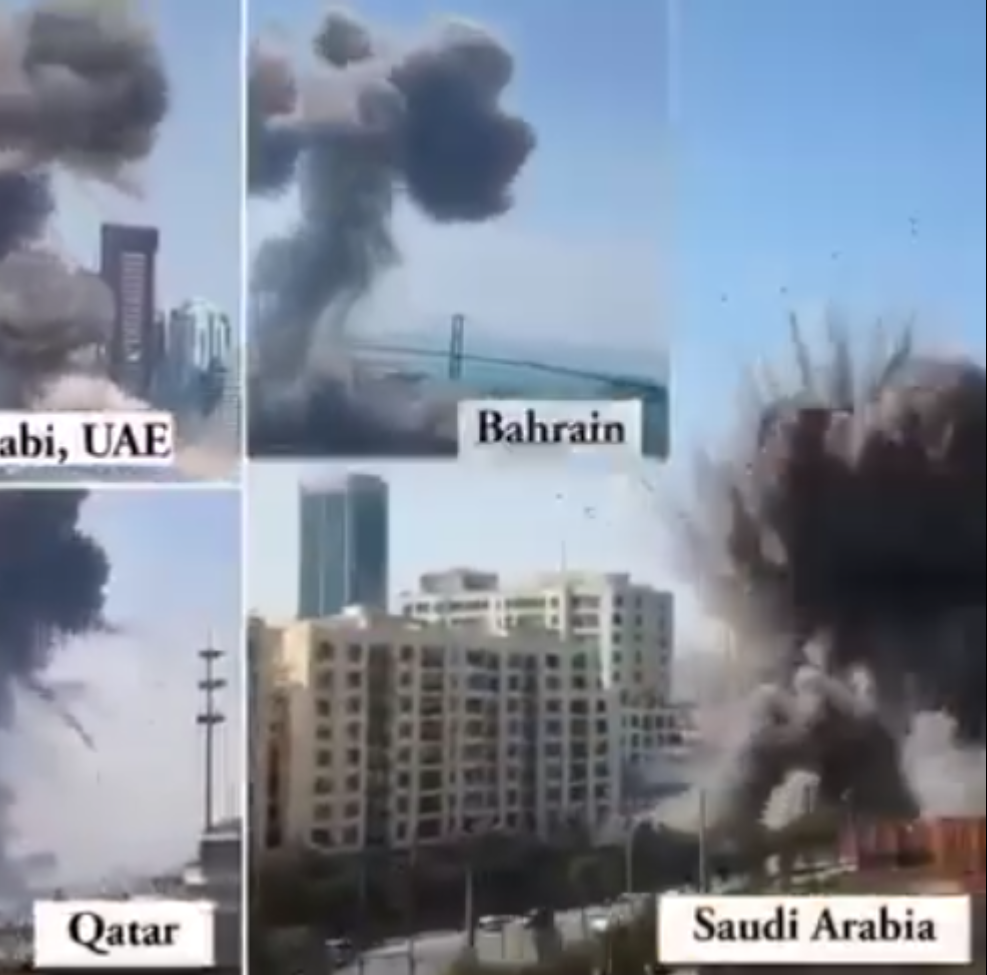
In Abu Dhabi, a powerful explosion was reported, prompting immediate concern. Authorities in the United Arab Emirates moved quickly to close the country’s airspace, a measure typically reserved for high-risk security threats. Reports indicated that the Al Dhafra Air Base may have been among the targets, allegedly struck by ballistic missiles.
Al Dhafra is a strategically significant base, hosting U.S. Air Force assets and serving as a key hub for operations across the Middle East. Any successful strike—or even an attempted one—carries both military and symbolic implications.
Meanwhile, in Manama, witnesses reported smoke rising from the Al Jufair district, home to the headquarters of the U.S. Navy’s Fifth Fleet. Bahrain plays a crucial role in maritime security, making any incident there particularly sensitive. Though details remain limited, the reports of an attack in such a location have intensified fears of a broader regional conflict.
Qatar and Kuwait: Defense Systems Activated
In Qatar, authorities issued urgent instructions for residents to shelter in place. The Ministry of Interior advised citizens to remain indoors and avoid unnecessary movement, signaling the seriousness of the threat. Reports suggested that a missile targeting the Al Udeid Air Base was intercepted by a Patriot missile defense system.
Al Udeid is one of the most critical U.S. military installations in the region, serving as a central command hub for air operations. A successful strike on this base would represent a major escalation, so the reported interception highlights the importance of advanced air defense systems in preventing catastrophic damage.
Qatar’s Defense Ministry later confirmed that several attacks had been successfully repelled and that the country had entered a state of high alert. Airspace closures followed, further underscoring the severity of the situation.
Similar тревожные developments were reported in Kuwait, where powerful explosions were heard. Authorities there urged citizens to remain at home and avoid workplaces, reflecting fears that additional strikes could occur. Kuwait hosts multiple U.S. military facilities and serves as a logistical hub, making it a potential target in any regional confrontation.
Understanding the Broader Context
To fully grasp the significance of these reported attacks, it is important to consider the broader geopolitical backdrop. Tensions between United States and Iran have been building for years, fueled by disputes over nuclear policy, regional influence, and military presence.
Recent developments—including alleged coordinated strikes by the U.S. and Israel on Iranian-linked targets—appear to have triggered a direct response. For Iran, launching attacks on U.S. bases represents both retaliation and a strategic message: that it has the capability and willingness to respond beyond its borders.
This type of escalation moves the conflict from indirect confrontations—often carried out through proxy groups—into a more direct and potentially dangerous phase.
Military Strategy and Capabilities
The reported use of ballistic missiles and drones highlights a modern approach to warfare. Iran has invested heavily in missile technology and unmanned aerial systems, allowing it to strike targets across the region without deploying large numbers of troops.
Ballistic missiles, in particular, are difficult to intercept and can carry significant destructive power. When combined with drones, which can overwhelm defense systems through sheer numbers, they create a complex threat environment.
On the other side, U.S. and allied forces rely on advanced systems such as the Patriot missile defense platform. These systems are designed to detect, track, and intercept incoming threats, but they are not foolproof. The success or failure of these defenses can significantly influence the course of a conflict.
Civilian Impact and Public Response
Beyond the ռազմական dimension, the situation has had an immediate impact on civilians across the Gulf. Governments in affected countries have issued emergency instructions, urging residents to stay indoors, avoid military zones, and follow official updates.
Airspace closures have disrupted travel, while businesses and public services have been temporarily halted in some areas. The psychological impact is equally significant, as uncertainty and fear spread rapidly during such crises.
Social media platforms have become a key source of real-time information, but they also contribute to confusion, as unverified reports circulate alongside official statements. In such moments, accurate communication becomes critical to maintaining public order.
Global Reactions and Economic Concerns
The international community is closely monitoring the situation. Any escalation in the Persian Gulf—one of the world’s most vital energy corridors—has immediate implications for global markets. النفط prices often react sharply to instability in the region, and prolonged conflict could disrupt supply chains.
Major world powers have called for restraint, emphasizing the need to avoid further escalation. Diplomatic channels are likely being activated behind the scenes, even as military readiness increases.
What Happens Next?
At this stage, the situation remains highly fluid. Much depends on how the involved parties choose to respond. Several scenarios are possible:
- De-escalation: Through diplomatic efforts and international pressure, tensions could ease, preventing further attacks.
- Limited Retaliation: Additional strikes may occur, but remain contained within certain حدود.
- Wider Conflict: A continued cycle of retaliation could draw in more countries, leading to a broader regional war.
Each of these outcomes carries different risks, but all highlight the fragile nature of the current situation.
Conclusion
The reported attacks on U.S. bases in the Persian Gulf mark a critical moment in Middle Eastern geopolitics. Whether fully confirmed or still developing, the الأحداث signal a dangerous escalation that could reshape regional dynamics.
From Abu Dhabi to Manama and across Qatar and Kuwait, the ripple effects are already being felt. Military readiness, civilian precautions, and global concern all point to the seriousness of the moment.
As the situation continues to evolve, the world watches closely—aware that decisions made in the coming hours and days could determine whether this crisis is contained or escalates into something far more consequential.