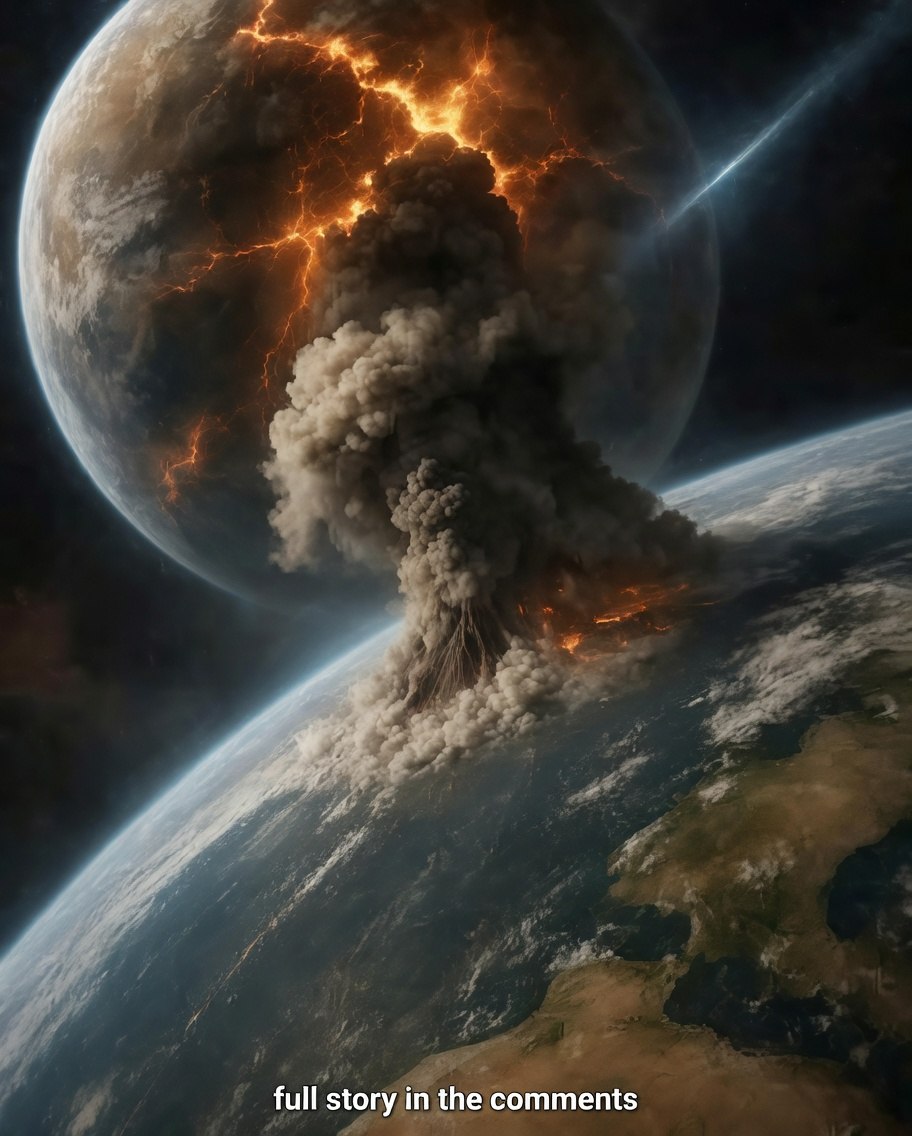
You stood in the kitchen holding your morning coffee when the TV screen flashed red with the emergency alert. A mountain of rock and iron, larger than any city you had ever seen, was screaming toward Earth at speeds no one could outrun. The announcer’s voice cracked as he read from the teleprompter, struggling to keep composure as the reality settled in—not just for him, but for everyone watching.
“At approximately 06:42 UTC, international space agencies confirmed the trajectory of asteroid 2026-QX… impact probability now calculated at 98.7%.”
Your coffee went cold in your hands.
Within minutes, every channel carried the same message. The asteroid, estimated at nearly 12 kilometers wide, had somehow gone undetected until it crossed beyond the sun’s glare. Now it was too close, too fast, and far too large. Social media erupted—some claimed it was a hoax, others posted prayers, while a growing number of scientists stepped forward with something even more unsettling than the asteroid itself: the truth about Earth’s defenses.
For years, you had heard about planetary defense systems—NASA’s DART mission, European tracking programs, even rumors of classified military technologies designed to deflect or destroy incoming threats. It had always sounded reassuring, like humanity had finally built a shield against the chaos of space.
But now the truth was being spoken aloud.
“We are not prepared,” said one astrophysicist during a live interview, her voice calm but her eyes betraying fear. “Our current technology is effective against smaller objects—tens to hundreds of meters. This… this is an extinction-level event. We do not have a tested system capable of stopping something this size on such short notice.”
The words echoed in your mind: we are not prepared.
Governments around the world scrambled to respond. Emergency summits were called. Military forces were placed on high alert—not because they could stop the asteroid, but because they feared what people might do once panic took hold. Shelves emptied. Highways jammed. Some sought shelter underground, others fled to remote areas, clinging to the idea that distance might somehow save them.
Then came the announcements of “last attempts.”
A coalition of nations revealed a desperate plan: a series of nuclear payloads would be launched to intercept the asteroid. The hope wasn’t to destroy it completely—that was impossible—but to alter its trajectory just enough to spare Earth a direct hit. It was a gamble, one never attempted at this scale.
As you watched the rockets lift off in synchronized brilliance, streaking across the sky like fragile arrows against an unstoppable force, something inside you shifted. This wasn’t just about survival anymore. It was about witnessing the limits of human power—and the strange, fragile beauty of trying anyway.
Days passed like hours. The world held its breath.
Then, the update came.
The intercept had succeeded… partially.
The asteroid had fractured.
But instead of one catastrophic impact, Earth now faced multiple massive fragments—still devastating, still deadly, but no longer guaranteed to wipe out all life. The largest fragment would strike an ocean, triggering tsunamis of unimaginable scale. Others would hit remote regions, deserts, and uninhabited land—by sheer luck as much as calculation.
It wasn’t victory. But it wasn’t extinction either.
Scientists called it a “narrow survival scenario.” Governments called it “hope.” People simply called their loved ones.
Standing there again in your kitchen, days after the first alert, you realized something unsettling and profound. Humanity had always believed it was in control—of nature, of technology, of its own future. But the asteroid had stripped away that illusion in a matter of hours.
The terrifying truth wasn’t just that a giant rock could end everything.
It was that, even with all our knowledge, all our progress, we are still beginners in a vast and unpredictable universe.
And yet, as those rockets had shown, we are also something else.
We are a species that refuses to stop trying—even when the odds are written in the stars.