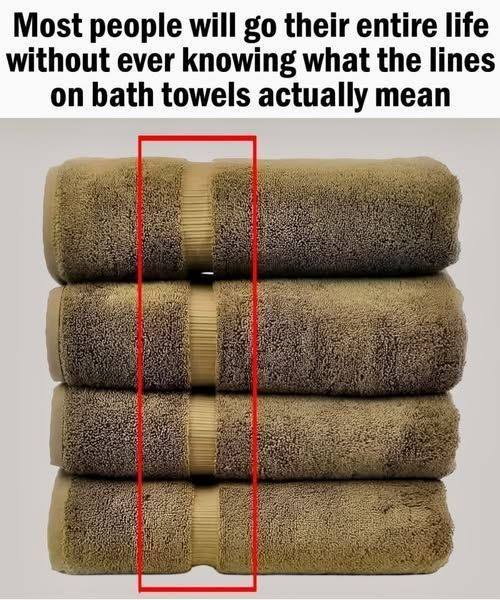
You’ve likely seen them countless times without giving them much thought—those subtle horizontal or vertical lines near the ends of your bath towels. They may seem like a simple design choice, something added purely for looks. But in reality, those lines have a name, a purpose, and a story rooted in textile craftsmanship. Once you understand their role, you may never look at your towels the same way again.
These lines are known as “dobby borders.” The term comes from a specific type of weaving technique that uses a dobby loom, which is designed to create small, geometric patterns in fabric. Unlike the soft, fluffy middle of a towel, which is made using looped terry cloth for maximum absorbency, the dobby border is tightly woven. This difference in texture is intentional and plays an important role in both the function and durability of the towel.
One of the main purposes of the dobby border is to reinforce the edges of the towel. Towels go through a lot—frequent use, repeated washing, drying, and general wear and tear. Over time, fabrics can begin to fray, especially at the edges where stress is highest. The dobby border acts like a built-in support system, helping to keep the towel intact. By strengthening these areas, it reduces the likelihood of loose threads and extends the overall lifespan of the towel.
Another important function is maintaining the towel’s shape. Washing machines and dryers subject fabrics to constant movement, twisting, and heat. Without structural reinforcement, towels could easily stretch out or lose their original form. The dobby border helps stabilize the fabric, ensuring that it keeps its shape even after dozens—or even hundreds—of wash cycles. This is why high-quality towels often feature well-defined borders; they are designed to last.
Beyond durability, these borders also serve a visual purpose. While towels are primarily functional items, manufacturers recognize that appearance matters too. The dobby border adds a subtle touch of elegance, breaking up the uniform texture of the towel and giving it a more refined look. Whether it’s a simple line, a geometric pattern, or a branded design, this detail can make a towel feel more luxurious—similar to what you might find in a hotel or spa setting.
In fact, some brands use unique dobby patterns as a form of identity. Just like a logo or a signature design, these patterns can help distinguish one product from another. Customers who are familiar with a certain brand may recognize its towels simply by the style of the border. It’s a small detail, but it contributes to the overall perception of quality and craftsmanship.
Interestingly, while the dobby border plays several important roles, it is not designed for absorbency. Because it is more tightly woven than the rest of the towel, it doesn’t soak up water as effectively as the soft, looped terry sections. This means that when you’re drying off, the middle of the towel is doing most of the work. The border is there for structure and style, not for drying. Using the central area will always give you better results.
Understanding this distinction can also help you take better care of your towels. For example, avoiding excessive pulling or stretching at the borders can help preserve their shape. Similarly, proper washing techniques—such as using moderate heat and avoiding overloading the machine—can ensure that both the absorbent sections and the reinforced edges remain in good condition over time.
In the end, what might seem like a minor design detail is actually a thoughtful combination of function and aesthetics. The dobby border represents the balance between durability, usability, and visual appeal. It shows how even everyday items are carefully engineered to perform better and last longer.
So next time you pick up a towel, take a closer look at those lines. They’re not just decorative—they’re a quiet example of smart design, working behind the scenes to make something ordinary a little more effective, and a little more refined.