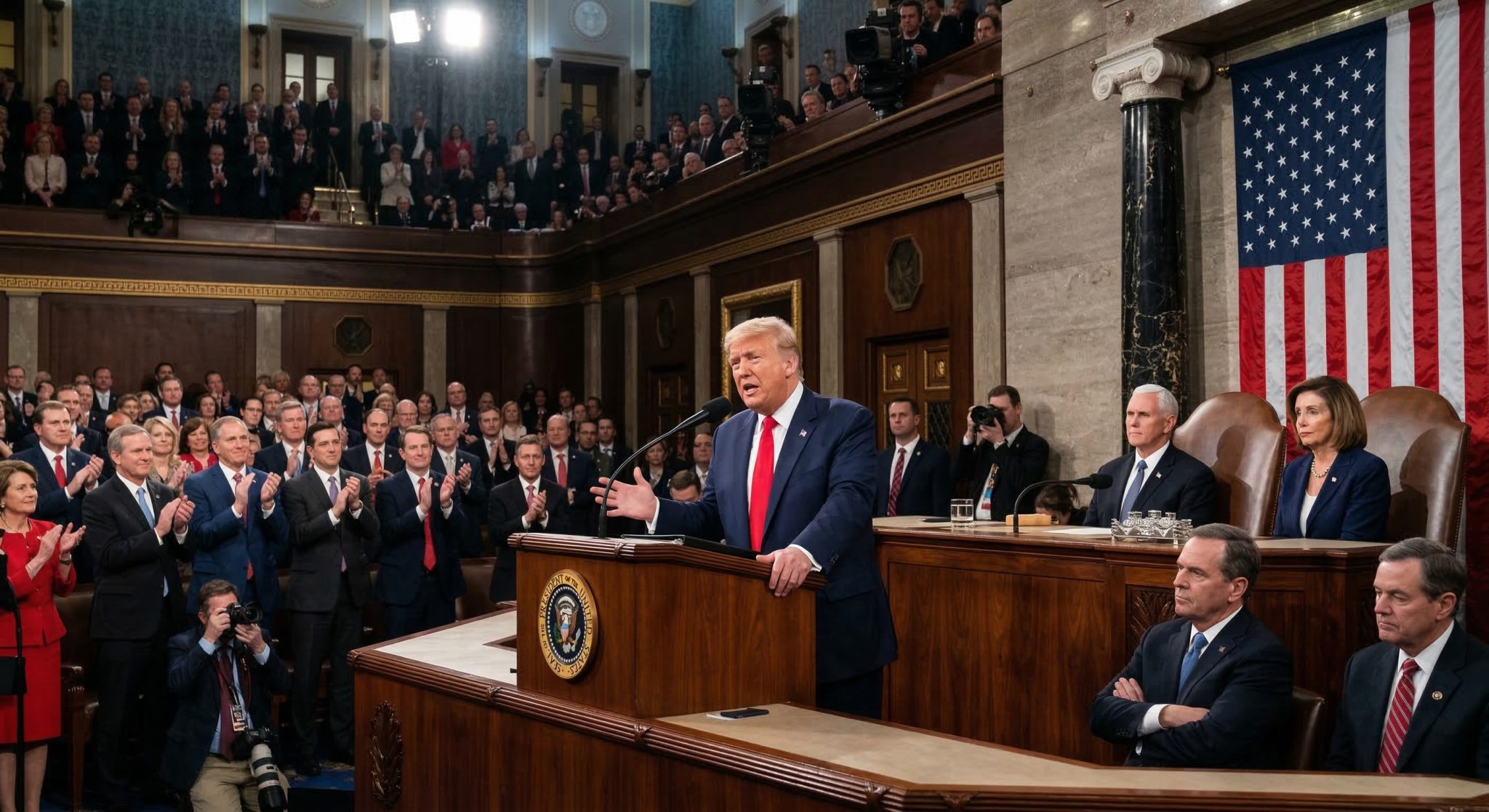
Televised presidential addresses rarely reshape public opinion overnight, but they still carry a unique ability to influence how Americans interpret the political moment. Donald Trump’s recent State of the Union speech demonstrated that power once again. According to CNN’s instant poll conducted with SSRS, viewers didn’t just watch the address—they reacted to it in a way that revealed both the persuasive force of a nationally televised speech and the deep political divisions that continue to define the United States.
The poll showed a noticeable surge in positive reactions among viewers. Nearly two-thirds of those who tuned in said they had a favorable response to the speech. Even more striking, a larger share of viewers left the address believing Trump’s policies would move the country in the right direction than felt that way before the speech began. For supporters, the address reinforced confidence in Trump’s leadership and his priorities. Themes surrounding immigration policy and the state of the economy—two of the most emotionally charged issues in American politics—resonated strongly with those watching.
For many viewers, the speech presented a clear narrative: a country confronting challenges but moving toward stability and growth. Trump emphasized economic performance, border security, and national strength, themes that have long been central to his political message. To supporters, the address projected decisiveness and clarity. For skeptics, however, it raised familiar questions about specifics and implementation.
The shift in viewer sentiment revealed by the poll illustrates how major political speeches can shape the mood of a moment, even if they do not dramatically change deeply held beliefs. The State of the Union remains one of the rare occasions when a president can speak directly to a massive national audience without interruption, framing the issues of the day on their own terms. In an era dominated by fragmented media and social platforms, that kind of shared national moment is increasingly rare.
Yet the poll numbers also reveal important context. The audience watching the speech was not a perfectly balanced cross-section of the American public. Like many politically significant broadcasts, the viewers were more politically engaged than average and, in many cases, somewhat sympathetic to Trump’s message before the speech even began. This means the address likely functioned more as reinforcement than conversion—strengthening the views of those already inclined to agree rather than persuading large numbers of skeptics.
That dynamic reflects the broader political climate in the United States. The country remains sharply polarized, with many voters interpreting the same message through completely different lenses. For some Americans, Trump’s focus on immigration and economic policy represented clarity and leadership. For others, it left questions unanswered and highlighted ongoing tensions in national policy debates.
In that sense, the speech did not so much transform public opinion as illuminate the divisions already present. The CNN-SSRS poll suggests that while presidential addresses can still energize supporters and influence how people feel in the moment, they rarely erase the deeper political fault lines shaping American society.
Rather than a turning point, Trump’s State of the Union served as a mirror—reflecting a nation still deeply split over what direction the country should take.