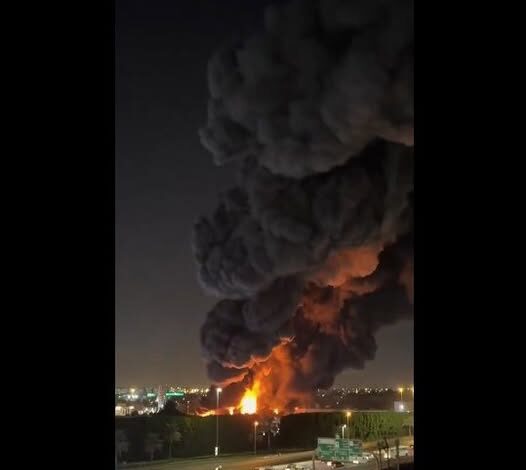
As the sun sets over the Eastern Mediterranean on March 2, 2026, the skyline of Tel Aviv and the surrounding districts has been transformed into a theater of high-velocity kinetic warfare. Following the morning’s seismic reports of a joint U.S.–Israeli strike that reportedly claimed the life of Iran’s Supreme Leader, the anticipated “Second Wave” of retaliation has arrived with terrifying precision. Israeli defense officials, operating under a state of total national emergency, have confirmed that a massive barrage of ballistic missiles, launched from various points within Iranian territory and potentially from proxy positions in Lebanon and Iraq, has breached national airspace, leading to multiple impacts in densely populated civilian corridors.
The sequence of events unfolded with a speed that tested the limits of even the world’s most sophisticated air defense architecture. At approximately 4:10 PM local time, the red alert sirens—a haunting, oscillating wail that has become the grim soundtrack of the decade—were activated across Central Israel. Residents from the coastal plains of Tel Aviv to the Judean Hills were given less than 90 seconds to reach hardened shelters. Families rushed down stairwells, businesses shut their doors mid-transaction, and highways momentarily froze as drivers abandoned vehicles to sprint toward nearby cover.
Above the cities, streaks of interceptor missiles cut through the fading daylight. Israel’s layered defense system—Iron Dome, David’s Sling, and the long-range Arrow interceptors—was immediately activated. From a distance, the sky appeared almost surreal, dotted with brief flashes as interceptors collided with incoming missiles high above the country. But defense officials quickly acknowledged a harsh reality: the attack was designed as a saturation strike. Dozens, possibly more than a hundred ballistic and cruise missiles were reportedly launched nearly simultaneously, overwhelming even advanced defensive systems.
Several projectiles slipped through.
Explosions echoed across multiple districts, sending towering plumes of smoke into the evening sky. Emergency services began receiving hundreds of distress calls within minutes. Reports of impacts surfaced in suburban areas around Tel Aviv, parts of central Israel, and communities west of Jerusalem.
The Tragedy in Beit Shemesh
The most devastating impact recorded in this latest escalation occurred in Beit Shemesh, a rapidly growing city situated between Tel Aviv and Jerusalem. According to early emergency reports, a heavy ballistic missile—believed by preliminary ballistics analysis to resemble a Fattah-class medium-range projectile—slammed into a religious complex within a residential neighborhood.
The explosion tore through the structure and surrounding buildings, leaving a crater and widespread structural collapse. Windows shattered across several blocks, vehicles were overturned, and debris scattered across nearby streets. Residents described a blinding flash followed by a shockwave strong enough to knock people off their feet.
Within minutes, Magen David Adom paramedics, Israeli police units, and Home Front Command search-and-rescue teams flooded the scene. Firefighters battled secondary blazes ignited by ruptured gas lines, while rescue crews began digging through collapsed walls and concrete slabs.
Witnesses reported chaotic scenes as neighbors attempted to help pull survivors from the wreckage before professional crews arrived. Medics established a triage zone nearby as helicopters circled overhead, preparing to evacuate the most severely injured to hospitals in Jerusalem and Tel Aviv.
Authorities have not yet released official casualty figures, but emergency services confirmed multiple fatalities and dozens of injuries ranging from blast trauma to burns and shrapnel wounds.
A Region on Edge
Israeli military officials described the attack as one of the largest direct missile barrages launched toward the country in recent history. Analysts believe the strikes were carefully coordinated, combining missiles launched directly from Iranian territory with those fired by allied militias positioned closer to Israel’s borders.
The Israeli Defense Forces (IDF) stated that additional interceptor batteries were being repositioned while fighter aircraft patrolled regional airspace in anticipation of further launches.
Government leaders convened an emergency war cabinet late in the evening as international diplomatic channels scrambled to assess the rapidly escalating crisis. Airports in Israel temporarily halted departures, and civilians were urged to remain near shelters until further notice.
Global markets reacted almost immediately. Oil prices surged amid fears that the conflict could spread across the Middle East, while governments worldwide issued urgent calls for restraint.
Yet on the ground in central Israel, the focus remains on rescue and survival. As night falls, floodlights illuminate shattered neighborhoods while search crews continue combing through rubble for survivors.
For residents of Beit Shemesh and other impacted communities, the day’s events have turned ordinary streets into scenes of destruction—an abrupt and devastating reminder that the escalating confrontation between regional powers has now arrived directly at their doorsteps.