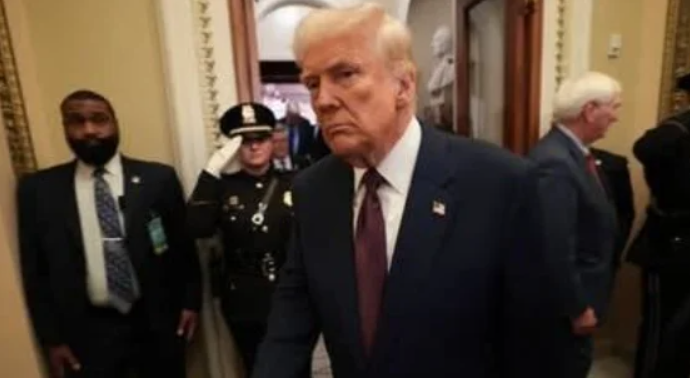
The U.S. Senate returned to session as Washington remained mired in a prolonged government shutdown, with pressure mounting on lawmakers to find a path forward. As federal workers continued to go without pay and essential services faced disruption, tensions inside the Capitol intensified. Behind closed doors, a fierce debate is unfolding over not just how to reopen the government, but how the Senate itself should function in the future.
At the center of the storm is former President Donald Trump, who has been urging Republican leaders to consider a dramatic institutional shift: eliminating the Senate filibuster. According to reporting from Politico, Senate Majority Leader John Thune has been engaged in discussions with Democrats over a temporary funding measure that would keep parts of the government operating through next January. The proposal, however, would still require 60 votes to overcome a filibuster—an obstacle Trump now argues should be removed entirely.
Speaking publicly, Trump framed the moment as a turning point. He called on Republicans to abandon the filibuster and use their majority to push through a sweeping agenda. In his view, doing so would allow lawmakers to pass voter identification requirements, restrict mail-in voting with limited exceptions, implement one-day voting, secure the border, and overhaul immigration policy without Democratic support. To Trump, the shutdown is not just a budgetary standoff but evidence that long-standing Senate rules are preventing decisive action.
Those remarks reportedly followed a tense breakfast meeting at the White House with Republican senators. During the discussion, Trump was said to have clashed with Senator Lindsey Graham, arguing that procedural tools like reconciliation are too limited to deliver meaningful change. He warned that failure to act boldly could leave the Republican Party politically weakened, urging senators to rethink their attachment to Senate traditions.
On Capitol Hill, reactions are sharply divided. Thune and other institutionalists continue to defend the filibuster, portraying it as a stabilizing force that prevents abrupt policy swings and protects minority voices. They argue that eliminating it could lead to legislative chaos, with laws rewritten every time control of the Senate changes hands. Trump’s allies counter that the filibuster has become an outdated roadblock, one that allows a determined minority to paralyze government even during national crises.
Democrats, meanwhile, are weighing their leverage carefully. Some are reportedly open to supporting a limited funding agreement to reopen the government, possibly in exchange for future votes on priorities such as healthcare subsidies or social spending. While such a deal could bring temporary relief, it also risks deepening divisions within both parties, as hardliners resist compromise.
Public frustration continues to grow as the shutdown drags on. Federal employees face financial strain, and the broader economy feels the ripple effects. Trump has amplified that pressure, warning Republicans that if Democrats regain unified control in the future, they could pursue dramatic changes of their own, such as granting statehood to Washington, D.C., and Puerto Rico or expanding the Supreme Court.
Whether this confrontation will end in a breakthrough or further entrench Washington’s paralysis remains unclear. What is certain is that the debate has moved beyond funding bills and into fundamental questions about power, procedure, and how far either party is willing to go to achieve its goals. The Senate, long known for its slow deliberation, is now under some of the most intense pressure it has faced in years.