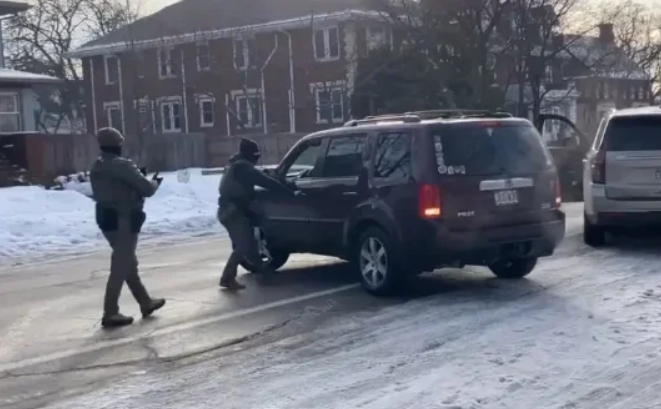
Recent reports from the New York Post allege that organizations characterizing themselves as radical leftist groups—including one receiving significant funding from billionaire George Soros—are driving the ongoing protests against Immigration and Customs Enforcement (ICE) in Minnesota.
Heightened tensions in Minnesota escalated this week following a deadly confrontation between a civilian and federal agents, an incident that has intensified protests, political debate, and scrutiny of activist organizations operating in the region. The flashpoint came Wednesday with the death of Renee Nicole Good during an encounter with Immigration and Customs Enforcement (ICE), an event now marked by sharply conflicting narratives and growing national attention.
According to federal authorities, the fatal shooting occurred after Good allegedly attempted to run over an ICE agent with her vehicle during an enforcement operation. Officials have characterized the incident as a life-threatening situation that required an immediate response. Activist groups and protest organizers, however, strongly dispute this account, arguing that Good was acting as a peaceful observer and posed no imminent threat. These competing versions of events have fueled outrage, demonstrations, and demands for transparency.
In the days following the shooting, protests opposing ICE activity intensified, with Indivisible Twin Cities identified as a primary organizing force. The group describes itself as a grassroots network of volunteers mobilized against immigration enforcement actions. While Indivisible Twin Cities operates locally, it is affiliated with the broader Indivisible Project, a Washington, DC–based organization formed in opposition to the Trump administration’s policies.
Public financial records show that between 2018 and 2023, the Indivisible Project received approximately $7.85 million in funding from the Open Society Foundations, chaired by George Soros. The organization’s stated mission includes defeating what it calls the “Trump agenda.” The broader Indivisible network has previously been linked to a range of high-profile demonstrations, including protests related to Venezuela and the nationwide “No Kings” protests aimed at the Trump administration.
Despite its visible role in organizing demonstrations, Indivisible Twin Cities maintains an opaque leadership structure, listing no specific leaders on its official website. This lack of transparency has drawn criticism from opponents, who argue it complicates accountability amid escalating tensions.
The death of Renee Nicole Good has become a central rallying point. At a demonstration following the incident, Jaylani Hussein, executive director of the Minnesota chapter of the Council on American-Islamic Relations (CAIR), accused authorities of misrepresenting what happened. Speaking through a megaphone, Hussein described Good as a peaceful “observer” and alleged that officials were spreading false information about the encounter.
Some left-leaning outlets have portrayed Good as a legal observer present during a raid on her home. Other reports describe her as a longtime anti-ICE activist who relocated from Colorado to Minnesota and was affiliated with “ICE Watch,” a collective focused on monitoring and disrupting ICE operations in Minneapolis.
Several prominent local activists have emerged as influential voices amid the unrest. Civil rights attorney Nekima Levy Armstrong, founder of the Racial Justice Network and a prominent figure during the 2020 George Floyd protests, has been linked through social media activity to organizing legal observers to document federal agents’ actions. Edwin Torres DeSantiago, head of the Immigrant Defense Network—an umbrella group representing more than 90 nonprofits and religious organizations—has also spoken out, accusing the Trump administration of spreading “terror and chaos” in Minneapolis.
Legal experts say the investigation may extend beyond the shooting itself. Fox News legal analyst Gregg Jarrett has suggested that authorities could examine whether others played a role in obstructing law enforcement. He noted that potential charges, such as aiding and abetting, would depend on evidence of intent to interfere with federal officers.
As investigations continue, the case has become a focal point in the broader national debate over immigration enforcement, protest movements, and the limits of activism—leaving a deeply divided community searching for answers amid grief and anger.