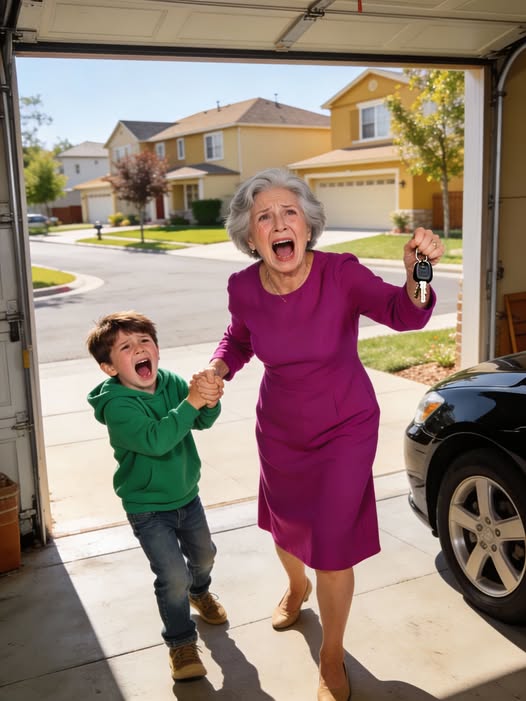
I was buttoning up my coat in the garage, my fingers clumsy and slow, as if grief itself had settled into my joints, when the sound of running footsteps shattered the quiet. The coat was black and stiff, bought hastily two days earlier, and it still smelled faintly of the department store—sharp, unfamiliar, nothing like the soft wool Michael used to tease me for wearing year after year. Forty-two years of marriage distilled into a single morning, into a funeral I was about to attend alone. The garage felt cavernous without him, every echo too loud, every breath too noticeable. I had already picked up my keys, already opened the driver’s door, when the door from the house flew open with a bang so loud it made me flinch. My grandson Lucas burst in, his face drained of all color, eyes wide and glassy, his chest heaving as if he’d run a mile. “Grandma, don’t start the car! Please, don’t!” he shouted, his voice cracking in a way that made my heart seize. I froze, the key hovering inches from the ignition. For a moment, my mind couldn’t make sense of what I was seeing—this wasn’t a tantrum, wasn’t teenage drama. This was terror, raw and unfiltered. “Lucas?” I whispered, my voice barely carrying. “What on earth is wrong?” He crossed the distance between us in three strides and grabbed my hand with both of his, gripping so hard it actually hurt. “You have to trust me,” he said, his words tumbling over each other. “We can’t take the car. We have to walk. Now. Please.” Something in his eyes—something far older than his fifteen years—made me obey without question. I slipped the keys into my pocket, my heart beginning to pound in a way that had nothing to do with grief, and let him pull me toward the open garage door, the cold morning air rushing in like a warning I didn’t yet understand.
We were halfway down the driveway when my phone began to buzz in my coat pocket, vibrating insistently against my ribs. I glanced down out of instinct, seeing Anna’s name flash on the screen, then David’s, then Anna again, one after the other in quick succession. My stomach twisted. Lucas noticed immediately and tightened his grip on my hand. “Don’t answer,” he pleaded, his voice dropping to a whisper. “Please, Grandma. Not right now.” I stopped walking, the gravel crunching under my shoes sounding unnaturally loud in the quiet street. I looked at him, really looked at him, and felt a cold certainty begin to form in my chest. “Lucas,” I said, forcing my voice to stay calm, “you need to tell me what’s going on. Right now.” He swallowed hard, his Adam’s apple bobbing, and for a long second he seemed unable to speak. When he finally did, his words were soft but devastating. “If you’d started that car,” he said, “we wouldn’t be standing here.” The world seemed to tilt. A gust of wind swept through the open garage behind us, carrying with it the smell of oil and concrete, and I had the strangest sensation that something invisible had just brushed past us—something close, something lethal. I didn’t know the details yet, but I felt it in my bones: whatever Lucas had stopped me from doing would have ended my life. The thought settled over me like frost, numbing and sharp all at once, and suddenly Michael’s death felt less like an ending and more like the opening act of something far darker.
We walked quickly, turning onto the street, then another, until we reached a small plaza a few blocks away where a few benches sat empty under bare trees. Only then did Lucas slow down, his shoulders sagging as if the adrenaline that had propelled him was finally draining away. He looked around, scanning the quiet morning as if expecting someone to appear, then sat down heavily on one of the benches. I lowered myself beside him, my knees trembling, my mind racing. “You said we wouldn’t be here,” I said carefully. “Explain that to me.” He rubbed his hands together, a nervous habit he’d had since he was little, and finally met my eyes. “I found something in the garage this morning,” he said. “Something that shouldn’t have been there.” The muscles in my neck tightened. “What did you find?” I asked. He hesitated, then took a breath. “There was a rag,” he said. “Stuffed into the exhaust pipe of your car. Pushed in deep.” For a moment, I couldn’t process the words. They floated in front of me, meaningless syllables, until their implication slammed into my chest. “Are you saying…” My voice failed me. He nodded. “If you’d started the engine with the garage door closed,” he said quietly, “the fumes would’ve filled the space fast. You wouldn’t have known what was happening until it was too late.” My hands flew to my mouth as a wave of dizziness washed over me. Carbon monoxide. An accident. A tragic widow found dead in her garage on the morning of her husband’s funeral. It would have looked so simple. So final. “How did you even notice?” I asked, my voice shaking. Lucas explained that he’d come over early because he didn’t want me to be alone on such a hard day. As he passed through the garage, something looked off. He crouched down, saw the rag, and felt his stomach drop. “I was going to pull it out before you came down,” he admitted. “But when I heard you opening the door, I panicked. I just… reacted.” I reached out and pulled him into a hug, my heart breaking all over again—this time not from loss, but from the realization that my grandson had saved my life.
As we sat there, the pieces began to arrange themselves in my mind, forming a picture I didn’t want to see. “Who has access to the house?” I asked slowly. Lucas’s shoulders slumped. “You know who,” he said. The list was painfully short: my daughter Anna, my son David, my daughter-in-law Laura. Family. The people who had been hovering around me since Michael’s death, offering help, pushing paperwork, insisting on meetings. Lucas hesitated, then added in a low voice, “I heard something else last night.” My heart sank. “What did you hear?” He stared at the pavement as he spoke. “Mom and Uncle David were arguing in the kitchen. They didn’t know I was on the stairs. They were talking about today. About how once you signed the papers, everything would be settled. And Mom said something like, ‘If she doesn’t cooperate, we’ll go with the other plan.’” My blood ran cold. The papers. The ones Anna had been so eager for me to sign, the ones David had brushed off as “just formalities.” Life insurance. Property transfers. Succession documents. All things that required my signature—and my continued existence. I felt a strange mix of nausea and clarity. “They wanted it to look like an accident,” I said, more to myself than to him. Lucas nodded. “Today was perfect,” he said bitterly. “Everyone distracted. The funeral. No one would question it.” Tears welled in my eyes, not just from fear, but from betrayal so deep it felt physical. My own children. The ones Michael and I had raised, loved, sacrificed for. I squeezed Lucas’s hand, grounding myself. “Listen to me,” I said, my voice steadier than I felt. “We’re going to the funeral. We’re not letting on that we know anything. And after that, we’re calling a lawyer. And the police.” He looked relieved and scared all at once, but he nodded. “I’m with you,” he said. And in that moment, I knew he meant it.
Walking into the church felt surreal, like stepping onto a stage where everyone was playing a part I now understood too well. The red-brick building was familiar, comforting in its way—the place Michael and I had attended every Christmas, every Easter, every community event. Anna rushed to me the moment she saw me, her face crumpling into perfectly timed tears. “Mom!” she cried, wrapping me in a hug. “We’ve been calling you nonstop. We were so worried!” I returned the hug, feeling how stiff her body was, how her eyes flicked over my shoulder toward Lucas. “I didn’t hear my phone,” I lied softly. David approached next, concern etched into his face, but there was something else there now that I couldn’t unsee—a calculation, a watchfulness. “Are you okay?” he asked. “You look pale.” “It’s been a difficult few days,” I replied evenly. Lucas stayed close to me, a quiet presence at my side, his hand brushing mine whenever he sensed my resolve wavering. During the service, I barely registered the pastor’s words. My mind replayed every interaction from the past week with brutal clarity: Anna’s insistence that we handle “logistics” immediately, David’s impatience when I asked questions, Laura’s thinly veiled irritation whenever I expressed uncertainty. It all fit now, every piece clicking into place. When the service ended and people began to file out, Anna and David flanked me, their urgency barely contained. “Mom, we really need to take care of the paperwork today,” Anna said, lowering her voice. “It’s important.” “It’ll be quick,” David added. “Then you can rest.” I stopped walking and turned to face them, Lucas’s hand firm in mine. “I’m not signing anything today,” I said. “And I won’t sign anything without my lawyer present.” The change in their faces was instantaneous. Anna’s mouth tightened. David’s eyes hardened. “You’re making this harder than it needs to be,” Anna snapped. “No,” I replied calmly. “I’m making it safe.”
The tension crackled between us, drawing curious glances from those nearby. Laura stepped forward, her smile strained. “Helen, this really isn’t the time for drama,” she said. I looked at her, then at my children, and felt a strange calm settle over me. “I found something in the garage this morning,” I said, loud enough for them all to hear. “And the police will be very interested in it.” The silence that followed was profound. Anna’s face drained of color. David’s jaw clenched so tightly I thought it might crack. Laura looked away. The masks they’d been wearing slipped, just enough for me to see what lay beneath. “I’m leaving now,” I said. “Lucas and I have appointments.” Without waiting for a response, I turned and walked toward the exit, my steps steady despite the storm raging inside me. Outside, the cold air hit my face, sharp and bracing, and for the first time since Michael’s death, I felt something like strength. I didn’t know what would come next—police reports, legal battles, shattered relationships—but I knew one thing with absolute certainty: I was alive. Because my grandson had trusted his instincts. Because I had listened. And because the truth, no matter how terrifying, had found its way into the light.