Most people never really see janitors. They pass by without slowing down, eyes locked on glowing screens, shoes clicking against polished floors that someone else cleaned only hours before. For decades, I learned how to move quietly through the world, how to exist without interrupting anyone’s sense of importance. My name is Martha, and I am sixty-three years old. For more than forty years, I worked nights—offices after the lights went out, rest stops when the highways finally slept, bathrooms echoing with nothing but dripping taps and humming vents. I learned the language of solitude early. Silence can be cruel, but it can also be honest. It gives you room to think, to remember who you were before life carved you into something smaller. I raised three children in that silence. Diana, Carly, and Ben grew up with my hands always smelling faintly of bleach and soap, with dinners that were simple but warm, with a mother who was always tired but always present. I believed—foolishly, perhaps—that those years would someday come back to me in small, ordinary ways. A knock on the door. A call that wasn’t rushed. A holiday where I wasn’t an afterthought. Instead, as they grew successful and busy, I slowly became a closed chapter. Their lives filled with granite countertops and vacations I saw only through photos. Mine stayed modest, predictable. Holidays came and went, each year with a new excuse that sounded reasonable until it stacked up against a decade of absence. I stopped expecting to be seen. I kept working, because work never abandoned me. It was honest. It showed up when I did. That was why I was at the interstate rest stop early that Tuesday morning, pushing a mop across cold tile while the sky outside was still black, thinking of nothing more than finishing my shift and going home to heat soup.
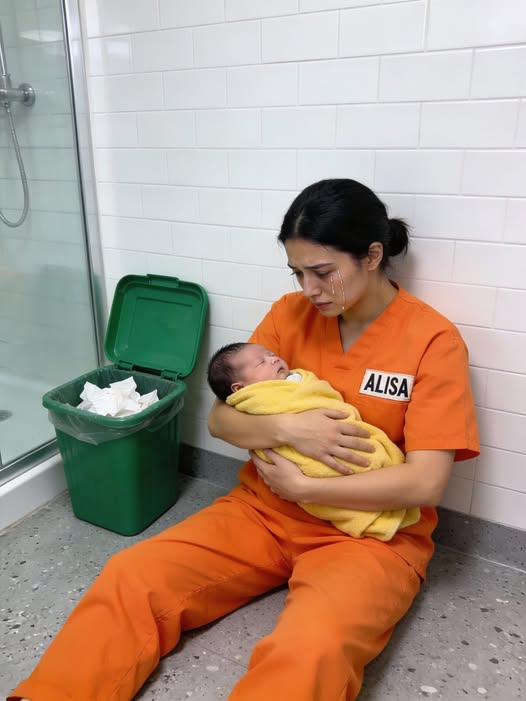
The sound came softly at first, so faint I almost ignored it. It didn’t belong in that place, and that was what made my chest tighten. It wasn’t the scrape of shoes or the slam of a stall door. It was thin, broken, desperate—too fragile to be part of the building itself. I stood still, mop dripping onto the floor, and listened again. When it came a second time, clearer, my body moved before my mind could catch up. I followed the sound to the back of the bathroom, behind the second trash bin that always overflowed. Kneeling on the cold tile, I pulled the bin aside and felt the world tilt. There, wrapped in a filthy, threadbare blanket among discarded paper towels and wrappers, was a newborn baby boy. His skin was cold, his body trembling, his cry already weakening as if he had used up most of what little strength he had. Someone had placed a faded hoodie beneath him, a small mercy that somehow made the cruelty worse. I didn’t think. I didn’t hesitate. I gathered him into my arms and pressed him against my chest, instinct rising from somewhere deeper than memory. In that moment—standing alone in a rest stop bathroom with a baby who had been thrown away—I felt something inside me wake up that I thought had died years ago. Purpose. Urgency. Love. There was a note tucked into the blanket, the words uneven and desperate: I couldn’t do it. Please keep him safe. I whispered to him without realizing I was speaking out loud, telling him I had him, that he was safe now, even though I had no idea what came next. All I knew was that for the first time in a very long time, someone needed me completely.
Everything after that happened quickly, but it never blurred together in my memory. A trucker named Tim walked in, froze at the sight of the baby, then immediately pulled off his jacket and called for help without a single question. The ambulance arrived, paramedics moved with practiced urgency, and one of them told me quietly that another hour in that cold could have ended very differently. I rode with the baby to the hospital, my hands still curved as if he were there even after they took him from my arms. They called him John Doe, but in my heart he already had a name—my little miracle. The social workers were kind but honest. My age, my work schedule, my income—none of it worked in my favor. When they told me no agency would approve placement unless I made changes, I didn’t argue. I changed my life instead. I gave up night contracts, sold what little I had saved, let go of things I’d held onto for years. I chose him. Six months later, when the paperwork became permanent and they placed a pen in my hand, my signature shook—not from fear, but from the weight of knowing that something abandoned had become something chosen. I tried to tell my grown children. I sent photos, messages, small pieces of joy I hoped they might share. The responses were polite at best, dismissive at worst. One of them asked if it was permanent, as if love were something you could return if it became inconvenient. It hurt, but it didn’t change anything. I had a baby to raise again, and this time, I understood exactly how precious that chance was.
John grew the way miracles do—quietly, steadily, without needing applause. He was curious in ways that startled me, asking questions about soil, stars, and how things healed. Our life was simple but full. He read constantly, turned jars into tiny ecosystems, and spoke with a kindness that made strangers soften around him. I watched him discover the world with the same wonder he once showed when he first curled his fingers into my shirt. When he won his first science competition, I stood in the back of the gym with tears running down my face, knowing I didn’t belong among the polished parents—but also knowing I had never belonged anywhere more. Years later, when he stood on a stage at a national conference and scanned the crowd until he found me, my heart nearly stopped. When he called me his mother in front of all those people, when he said I was the reason he was there, the applause sounded distant. All I could hear was the echo of that first cry in the bathroom, now transformed into something strong and certain. Life, of course, didn’t stop testing us. When I fell and broke my hip, when pain pinned me to a bed and the house grew quiet again, it was John who came running. John who cooked, cleaned, read to me, and sat through the long nights without complaint. I realized then that love doesn’t measure itself in bloodlines or biology. It reveals itself in who stays.
When I updated my will, it wasn’t an act of defiance or revenge. It was truth put into writing. My biological children had chosen distance long before money was involved. John had chosen presence every single day. The reaction was exactly what I expected—anger, accusations, threats—but none of it reached me the way it once would have. I had already made peace with who my family truly was. Sitting on the porch one night, watching John trace constellations in the sky, I thought back to that cold morning at the rest stop. I didn’t remember fear anymore. I remembered purpose. I didn’t remember saving a life. I remembered finding one—and being found in return. In the end, I gave him everything I had, not because he needed it, but because he had already given me the one thing I thought I’d lost forever: the certainty that I mattered. And that, more than anything, was the miracle we saved together.