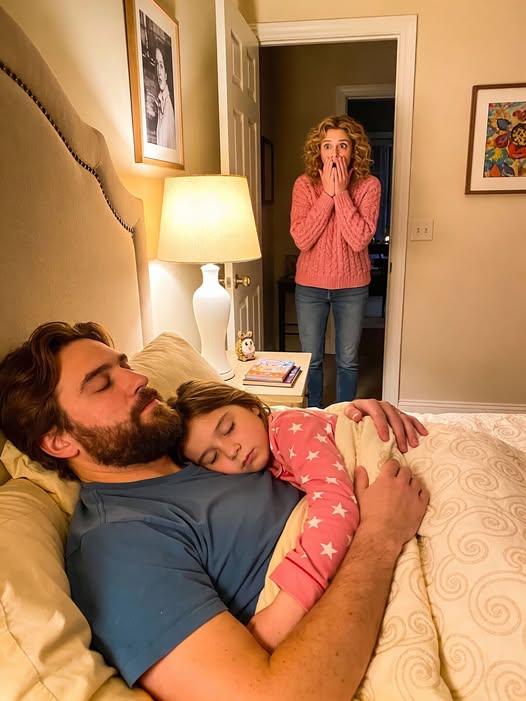
The first time my daughter mentioned it, I laughed it off without a second thought. It was an ordinary weekday morning, sunlight spilling across the kitchen tiles as I packed her lunch and reminded her—again—not to forget her water bottle. Emily stood beside me in her pajamas, hair still tangled from sleep, rubbing one eye as she leaned against the counter. “Mom,” she said in that half-dreaming voice children have when they’re not fully awake yet, “my bed felt really small last night.” I smiled and brushed it aside, even teased her gently. Her bed was enormous for an eight-year-old—wide enough that she could roll from one side to the other without ever touching the edge, a mattress we’d bought specifically because we wanted her to feel comfortable, secure, and independent. I assumed she’d kicked her blankets off or piled her stuffed animals too close again. But as the days passed, the comment didn’t disappear the way childhood quirks usually do. It returned every morning in a slightly different form. Sometimes she said she hadn’t slept well. Sometimes she said she’d woken up pressed against the side rail. Once, she hesitated before asking if I’d come into her room during the night. That question lodged itself in my chest like a stone. I told her no, of course not, and laughed the way parents do when they want to smooth over something unsettling without letting fear show. Still, after she left for school, I stood alone in the hallway staring at her closed bedroom door, listening to the house breathe. I told myself it was imagination, growing pains, bad dreams. But motherhood teaches you to recognize when something is off, even if you can’t yet name it, and from that moment on, sleep no longer came easily to me.
I tried to approach it logically at first. I checked her bed every night before turning off the light, smoothing the sheets, counting stuffed animals, making sure nothing could be crowding her space. I left the door slightly open so the hall light spilled in, adjusted the nightlight, asked her gently if anything scared her. Emily always shook her head. She wasn’t frightened, she said. Just uncomfortable. “It feels like I don’t have enough room,” she explained one evening, frowning as if trying to solve a puzzle with words that didn’t quite fit. “Like I have to move over.” The way she said it—so matter-of-fact, without drama—made my skin prickle. My husband Daniel listened to me recount this one night while he loosened his tie, exhaustion etched into his face after a double shift at the hospital. He kissed my cheek and told me not to worry. Kids imagined things. Our house was safe. Nothing strange was happening. I wanted to believe him, and part of me did, but another part—the quiet, stubborn part that had kept me awake since Emily’s question—refused to settle. A few days later, without telling anyone, I ordered a small security camera. I told myself it was just for peace of mind, something to prove that nothing was wrong. Installing it felt almost silly, but the moment it blinked on in the corner of Emily’s room, I felt a strange sense of control return. That night, I checked the feed before bed. Emily slept sprawled diagonally across the mattress, blankets kicked halfway to the floor, exactly as children do when they have all the space in the world. I went to sleep convinced I’d been
I woke sometime after two in the morning, throat dry, the house wrapped in that deep, echoing quiet that only exists when everyone else is asleep. As I padded toward the kitchen for a glass of water, I glanced at my phone, intending to check the time—and without really thinking, I opened the camera app. The image loaded slowly, pixel by pixel, and for a split second everything looked normal. Emily lay on her side, facing the wall, breathing evenly. Then I noticed the door. It wasn’t fully closed anymore. It was moving. My heart began to race as I watched it open inch by inch, silently, the way doors do when someone knows exactly how to avoid making noise. A figure stepped into the room, thin and slightly hunched, moving with a slowness that spoke of age rather than menace. Gray hair caught the dim glow of the nightlight. I pressed my hand to my mouth, tears welling before my mind could even process what I was seeing, because recognition hit me all at once. It was my mother-in-law. Margaret. She crossed the room carefully, as if afraid of waking Emily, and stood beside the bed for a moment, looking down at her sleeping granddaughter. Then, with a tenderness that broke something open inside my chest, she lifted the blanket and slid beneath it, settling herself beside Emily as naturally as if she’d done it every night of her life. Emily shifted, murmured softly, and rolled closer to the edge, her small body unconsciously making room. I sank down onto the kitchen floor, phone clutched in my trembling hands, and cried without sound, because suddenly everything made sense. The bed wasn’t too small. It was simply being shared.
Margaret was seventy-eight years old and had lived a life shaped by quiet sacrifice. She’d raised Daniel alone after his father died suddenly, worked jobs that broke her body and paid almost nothing, and somehow still managed to give her son opportunities she’d never had herself. I knew the stories by heart—how she’d skipped meals so Daniel could eat, how she’d walked miles to work when buses were too expensive, how she’d never complained even when life asked everything of her and more. In recent years, though, something had begun to slip. Small things at first: repeating questions, forgetting names, moments of confusion that she laughed off with a wave of her hand. Then came the doctor’s appointment, the gentle but devastating words we’d all been trying not to hear. Early-stage Alzheimer’s. We adjusted, helped more, reminded ourselves it would be gradual. What we hadn’t prepared for was how the nights would affect her, how the darkness and quiet would blur past and present until memories felt more real than the room she stood in. Watching her now on that screen, curled carefully around Emily like a shield, I realized she wasn’t intruding. She wasn’t doing anything malicious or even inappropriate in her own mind. She was searching for something familiar, something safe. She was reaching for a child in the way she once reached for her own son, guided not by intention but by instinct, by love that had nowhere else to go.
The next morning, I showed Daniel the footage. He sat at the kitchen table long after it ended, elbows on the wood, head bowed, tears slipping down his cheeks in silence. “She thinks Emily is me,” he said finally, his voice thick. “Or she thinks she’s back in the old house. Or maybe she just doesn’t want to be alone.” We didn’t blame Margaret. There was no anger in either of us, only a deep, aching sadness mixed with resolve. Emily slept in our bed for the next few nights, happy to be close, unaware of the full reason why. We moved Margaret’s room closer to ours, installed gentle alarms and motion sensors, not as barriers but as safeguards. More importantly, we changed how we treated her nights. I began sitting with her before bed, listening as she told the same stories again and again, holding her hand until she drifted off, reminding her softly that she was safe and not alone. The wandering stopped. Emily stopped complaining about her bed. Life didn’t return to normal—it shifted into something new, something quieter and more intentional. I learned that independence doesn’t mean isolation, and that care isn’t always about rules and boundaries but about understanding what someone is truly asking for, even when they can no longer say it clearly. My daughter’s bed was never too small. It was my heart that had been, closed off to a truth I didn’t want to see until a silent camera showed me love moving through the darkness, searching for a place to rest.