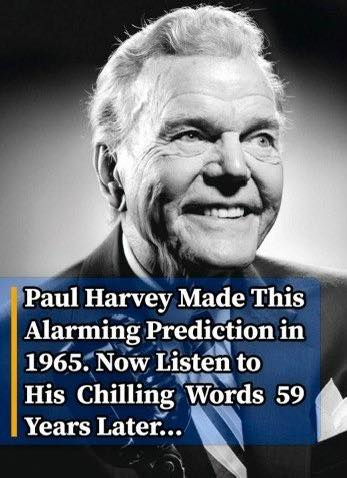
In the quiet kitchens of mid-century America, the rhythmic ticking of a wall clock was often accompanied by the steady, distinctive cadence of Paul Harvey. For decades, his voice was a staple of the American airwaves, delivering “The Rest of the Story” with a mixture of wit, wisdom, and a deep-seated concern for the moral compass of the nation.
Today, as we look back on his most famous broadcasts—specifically the haunting “If I Were the Devil” monologue—many feel a sense of chilling recognition. It wasn’t that Harvey possessed a crystal ball; it was that he understood the fundamental mechanics of human nature and societal decay. He didn’t just predict a future; he provided a map of the consequences that arise when a society prioritizes comfort over character.
The Anatomy of a Warning
To understand the weight of these warnings, we must first look at the context in which they were delivered. Paul Harvey wasn’t speaking to a crowd of radicals; he was speaking to the heart of the “silent majority.” His words were meant to be a mirror, reflecting the subtle shifts in culture that often go unnoticed until they have become permanent fixtures.
The core of his message was simple yet profound: A nation is not destroyed by external forces alone, but by the gradual erosion of its internal values. He spoke of a world where right becomes wrong, and wrong becomes a right—a world where the pursuit of “easy feelings” replaces the pursuit of hard truths.
The Shift from Duty to Distraction
One of the most poignant aspects of the warning involves the transition from a culture of duty to a culture of distraction. In Harvey’s view, the greatest threat to a stable society is not necessarily a grand, visible evil, but a persistent, low-grade apathy.
- The Pursuit of Comfort: When comfort becomes the ultimate goal, sacrifice becomes an outdated concept.
- The Rise of Outrage as Entertainment: We have entered an era where being offended is a form of social currency, and outrage is consumed with the same fervor as a sporting event.
- The Death of Nuance: In a world of soundbites, the “hard questions” Harvey championed are often buried under a mountain of simplified, polarized rhetoric.
Analysis: Why the Map Remains Accurate
Why do these decades-old broadcasts feel more relevant in 2026 than they did in the 1960s? The answer lies in the psychological phenomenon of “gradualism.” Societal change rarely happens in a sudden explosion; it happens in small, incremental steps that normalize behaviors that were once unthinkable.
The Echo Chamber Effect
Harvey warned of a time when people would seek out only the voices that confirmed their own biases. Today, through social media algorithms and fragmented news sources, we have built the ultimate version of that warning. We “baptize our preferences as truth,” as the original text suggests, creating a cycle where growth is impossible because we never encounter a thought that challenges us.
The Erosion of Personal Responsibility
At the heart of any functioning republic is the concept of personal accountability. When we stop asking “What can I do to improve things?” and start asking “Who can I blame for my discomfort?”, we move further away from the foundation Harvey admired. The warning wasn’t just about political shifts; it was about the individual soul.
Moving Beyond the “Prophecy”
It is easy to listen to these old warnings and feel a sense of despair or “doom-scrolling” nostalgia. However, the true value of a warning is not to crown the messenger as a prophet, but to use the information to change course. If we treat the broadcast as a finished story, we miss the point. It is an invitation to action.
Choosing the Difficult Path
Turning back from a culture of distraction requires a deliberate, often uncomfortable choice. It means:
- Prioritizing Critical Thinking: Actively seeking out information that challenges our worldview.
- Valuing Character Over Applause: Making decisions based on long-term ethics rather than short-term social validation.
- Returning to Local Connection: Rebuilding the small, daily interactions that form the actual fabric of a community, rather than living purely in the digital ether.
Conclusion: The Mirror in the Room
The “warning you ignored” is only a tragedy if the ignorance continues. We are currently living in the world that previous generations were warned about, but that doesn’t mean the story is over.
Paul Harvey’s voice may be a memory, but the principles he stood for—honesty, hard work, and the courage to face the truth—are timeless. We can continue to consume outrage like entertainment, or we can look into the mirror, admit how far we have drifted, and begin the slow, necessary work of steering the ship back toward a more meaningful horizon.