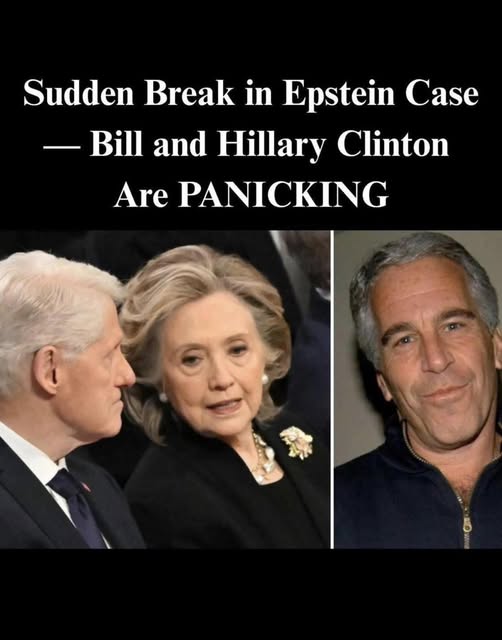
Former President Bill Clinton and former Secretary of State Hillary Clinton have postponed their scheduled depositions before the House Oversight Committee, according to congressional officials, adding another layer of complexity to the committee’s ongoing investigation into the federal government’s handling of the Jeffrey Epstein and Ghislaine Maxwell cases.
A spokesperson for the committee confirmed Monday that neither Clinton appeared on their originally scheduled dates. Hillary Clinton had been expected to testify last week, while Bill Clinton was scheduled to sit for questioning on Tuesday. The postponements, while not uncommon in congressional investigations involving high-profile witnesses, have nonetheless drawn public attention given the subject matter and the prominence of those involved.
“The deposition won’t occur tomorrow,” the spokesperson told The New York Post, adding that the committee is “having conversations with the Clintons’ attorney to accommodate their schedules.” As of now, no new dates have been announced, and committee officials have not indicated whether additional legal steps will be taken to compel testimony if scheduling challenges persist.
Background of the Oversight Committee Investigation
The subpoenas were issued in early August by House Oversight Committee Chairman James Comer (R-KY) as part of a broader inquiry into how federal authorities handled investigations, prosecutions, and oversight related to Jeffrey Epstein and his longtime associate, Ghislaine Maxwell. The investigation seeks to examine whether institutional failures, delayed actions, or overlooked evidence allowed Epstein’s criminal activity to continue for years despite multiple warning signs.
Comer has stated that the committee’s focus is not limited to individual wrongdoing, but rather to systemic accountability within the Department of Justice, the Federal Bureau of Investigation, and other federal agencies. According to committee leadership, the inquiry aims to identify whether officials failed to act on credible information, exercised poor judgment, or applied uneven standards when dealing with Epstein and his network of influential associates.
“This is about accountability and transparency,” Comer said in August. “The American people deserve to know how someone like Jeffrey Epstein was able to evade meaningful consequences for so long.”
Notably, Comer emphasized that the subpoenas for the Clintons were approved with bipartisan support, an unusual development in today’s polarized political environment. That bipartisan backing suggests a shared interest among lawmakers in understanding how Epstein’s case was managed, regardless of party affiliation.
Epstein, Maxwell, and the Federal Case History
Jeffrey Epstein, a wealthy financier with extensive social and political connections, was arrested in July 2019 on federal charges of sex trafficking minors. The arrest followed years of controversy surrounding a 2008 non-prosecution agreement in Florida that allowed Epstein to avoid federal charges despite serious allegations.
In August 2019, Epstein was found dead in his Manhattan jail cell while awaiting trial. Federal prosecutors later ruled his death a suicide, though the circumstances—particularly failures in jail supervision—sparked widespread public skepticism and ongoing debate.
Ghislaine Maxwell, Epstein’s longtime associate, was arrested in 2020 and convicted in 2021 of conspiring with Epstein to sexually abuse minors. She is currently serving a 20-year federal prison sentence. Maxwell’s trial and subsequent sentencing renewed public interest in Epstein’s network and raised questions about whether others who interacted with him were adequately investigated.
The House Oversight Committee’s inquiry exists alongside other reviews and reporting efforts that have sought to understand how Epstein maintained influence, avoided accountability, and continued operating despite repeated allegations.
Why the Clintons Were Subpoenaed
The Clintons are not accused of any criminal wrongdoing in connection with Epstein or Maxwell. However, their names have long appeared in public records and media reporting related to Epstein’s social and professional circles.
According to White House visitor logs released in 2016, Epstein visited the Clinton White House at least 17 times between 1993 and 1995. Records also show that Epstein donated $10,000 to the White House Historical Association in 1993. These interactions occurred during Bill Clinton’s presidency, prior to Epstein’s first criminal conviction.
Bill Clinton has also acknowledged traveling on Epstein’s private jet—sometimes referred to in media as the “Lolita Express”—on multiple occasions. Clinton has said these trips were connected to his work with the Clinton Foundation and its global humanitarian initiatives.
In his 2024 memoir Citizen: My Life After the White House, Clinton expressed regret over those associations. “I wish I had never met him,” Clinton wrote, adding that traveling on Epstein’s plane “was not worth the years of questioning afterward.”
Clinton has consistently denied visiting Epstein’s private island in the U.S. Virgin Islands and has stated that he had no knowledge of Epstein’s criminal activity.
Committee Leadership and Public Statements
Chairman Comer has been direct about why the Clintons’ testimony is of interest to the committee. In an interview with Newsmax in August, Comer said the panel intends to explore Epstein’s relationships with high-profile individuals to determine whether federal agencies treated those connections differently during investigations.
“Everybody in America wants to know what went on at Epstein Island,” Comer said. “We’ve all heard reports that Bill Clinton was a frequent visitor there, so he’s a prime subject to be deposed by the House Oversight Committee.”