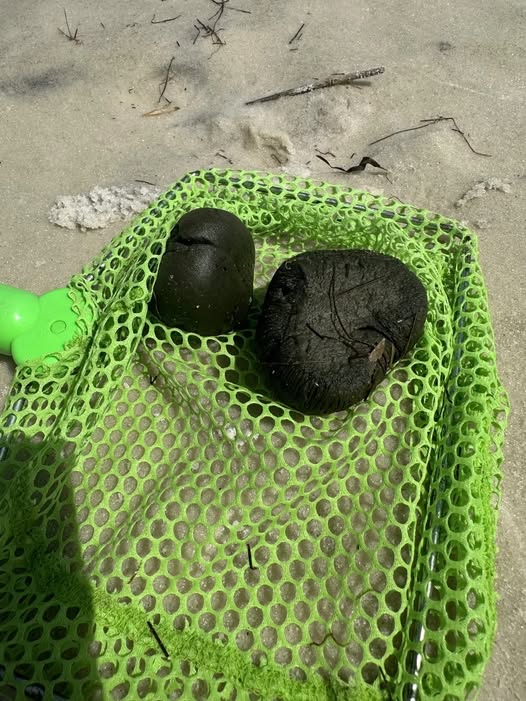
In the soft, rhythmic environment of the Gulf Coast, a day at the beach is often more than just a brief escape into the sun and salt air. For families exploring the serene shorelines of Pensacola Bay, it is frequently a masterclass in the quiet wonders of marine biology and geology. Along the water’s edge, where the gentle lap of the tide meets the fine, white sands, children often stumble upon curious objects that spark immediate intrigue: small, dark, squishy spheres that seem out of place among the bright shells and weathered driftwood.
While these finds are often met with a mix of laughter and “gross-out” humor by children—who frequently assign them imaginative, albeit unrefined, nicknames—the true story of these objects is a fascinating look at the unique sedimentary dance of an estuarine environment. These objects, known scientifically as mudballs (or more specifically, “armored mudballs” when they pick up a coating of sand and shell), are a natural phenomenon that tells the story of the bay’s history, its health, and its hidden depths.
Health
The Anatomy of an Estuarine Mystery: What Are Mudballs?
To the untrained eye, a mudball can look like anything from a piece of weathered asphalt to a strange organic pod. However, these formations are entirely natural and are a direct product of the low-energy, sediment-rich waters of the Pensacola Bay system.
Unlike the high-energy “surf zones” of the open Gulf of Mexico, where powerful waves grind everything into fine powder, the bay is a protected nursery. Here, fine particles of clay, silt, and organic matter settle into thick, cohesive layers on the floor of the bay. Over time, these layers become compacted and firm.
The Lifecycle of a Mudball
The creation of a mudball is a process of physical transformation that occurs in several distinct stages:
- Erosion and Detachment: During heavy rains, seasonal storms, or even changes in the current, chunks of the compacted clay and silt are torn away from the bay’s bottom or from the edges of tidal marshes.
- The Rolling Motion: Once a fragment is loose, the gentle, back-and-forth action of the tides acts like a natural potter’s wheel. As the fragment rolls across the sandy bottom, the friction smooths its rough edges, eventually shaping it into a sphere or an oval.
- Armoring: As the sticky mudball travels, it often picks up a “skin” of sand, tiny pebbles, or crushed shell fragments. This process, known as armoring, creates a protective outer layer that helps the mudball retain its shape even after it washes ashore and begins to dry.
- Organic Enrichment: The dark green or charcoal color of these balls is typically due to the presence of anaerobic organic matter—decayed seagrasses and ancient plant material trapped within the clay.
Environmental Indicators: Why Pensacola Bay?
Pensacola Bay is a unique setting for these discoveries because it acts as a massive “settling basin.” The bay receives freshwater discharge from several rivers, including the Escambia and Blackwater Rivers, which carry fine sediments from the interior of Florida and Alabama. When this freshwater meets the saltwater of the Gulf, the change in salinity causes fine clay particles to “flocculate”—stick together and sink to the bottom.