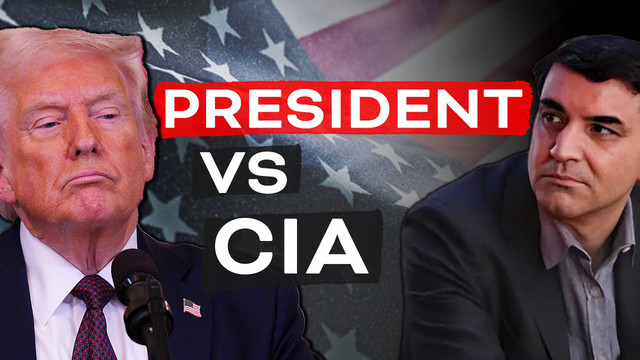
In the broad sweep of American history, few actions more starkly test the guardrails of the constitutional republic than when former high-ranking officials, once entrusted with enormous authority, publicly call for the removal of a duly elected president. Such statements inevitably raise questions that extend far beyond one administration or one political dispute. They touch on the limits of executive power, the meaning of presidential fitness, the role of national-security officials in political debates, and the delicate balance between constitutional safeguards and democratic legitimacy.
Former CIA Director John Brennan stepped into that debate with a highly consequential argument, advocating consideration of the 25th Amendment to remove President Donald Trump amid escalating tensions involving Iran. Brennan characterized Trump’s rhetoric as deeply concerning and suggested that the constitutional provision appeared particularly relevant to the current president. His comments came against a backdrop of increasingly aggressive warnings directed toward the Iranian regime and growing fears that a confrontation could develop into a broader military crisis.
The controversy surrounding Brennan’s remarks is not simply about whether one agrees or disagrees with Trump’s foreign-policy approach. The more fundamental issue is whether disagreements over presidential judgment, rhetoric, or national-security decisions should ever rise to the level of constitutional removal.
The 25th Amendment was adopted to address situations in which a president is unable to discharge the powers and duties of the office. Its existence reflects an important principle: the presidency is an institution larger than any individual occupying the Oval Office. At the same time, invoking such a mechanism is an extraordinary step. It is not designed merely as a political weapon against a president whose decisions are unpopular, controversial, or strongly opposed by former government officials.
That distinction is central to the Brennan controversy.
Critics of Trump’s conduct may argue that presidential decision-making involving Iran requires exceptional caution. A president’s words can have consequences beyond domestic politics. Statements directed at foreign governments can influence military calculations, diplomatic negotiations, financial markets, and the behavior of allies and adversaries. From that perspective, Brennan’s concerns can be interpreted as a warning from someone with extensive experience in national security.
Yet there is another side to the argument. Former intelligence and national-security officials possess enormous credibility precisely because of the positions they once held. When someone such as Brennan publicly suggests that a sitting president should be removed, his words can carry an authority that ordinary political criticism does not. That makes such intervention especially consequential.
Supporters of Brennan may contend that former officials have a responsibility to speak when they believe national security is endangered. They could argue that remaining silent in the face of what they perceive as reckless presidential behavior would itself be irresponsible. In their view, the 25th Amendment is not inherently partisan; it exists as a constitutional safeguard intended for extraordinary circumstances.
Opponents, however, can reasonably question whether political and policy disagreements are being transformed into arguments about constitutional incapacity. A president can make decisions that critics consider dangerous, reckless, inflammatory, or misguided without necessarily being constitutionally incapable of performing the duties of the office.
That distinction matters enormously.
America’s constitutional system depends not only on written laws but also on political restraint. Every major constitutional mechanism carries the possibility of being abused if political actors begin treating extraordinary procedures as routine tools of partisan conflict. If every deeply controversial president were described as mentally or constitutionally unfit whenever political tensions became intense, the stability of the system could gradually be weakened.
The controversy also reflects a broader problem in American politics: declining trust between institutions and political factions. For many Americans, Brennan’s remarks may be viewed not as an isolated assessment of presidential fitness but as part of a continuing struggle between Trump and members of the national-security establishment who have criticized him for years. Supporters of Trump may therefore interpret the call as evidence of institutional opposition rather than an objective constitutional concern.
At the same time, Trump’s supporters face their own responsibility. Dismissing every criticism from former intelligence officials as partisan hostility would be equally dangerous. National-security concerns deserve serious examination regardless of which political party occupies the White House.
The Iran question makes the debate even more sensitive. The United States has repeatedly found itself confronting the difficult choice between deterrence and escalation in the Middle East. Presidential threats can sometimes be intended to prevent conflict by convincing an adversary that the costs of aggression will be overwhelming. But the same rhetoric can also increase the risk of miscalculation if foreign leaders interpret threats differently than the president intended.
This is why the public debate should focus on evidence rather than personalities.
Is the president actually unable to perform the duties of office? Is there demonstrable evidence of constitutional incapacity? Are national-security decisions being made through established institutions and procedures? Are military and intelligence professionals providing appropriate assessments? And are political opponents using the language of constitutional crisis simply because they strongly disagree with the president?
Those questions are far more important than whether Brennan’s comments generate headlines.
The 25th Amendment exists for a serious constitutional purpose, and it should not be reduced to a slogan. Likewise, criticism of presidential behavior is an essential component of a free society and should not automatically be treated as disloyalty. Former officials have the right—and sometimes the responsibility—to warn the public about what they believe are serious threats.
But extraordinary constitutional remedies require extraordinary justification.
The Brennan controversy therefore reveals something larger than a dispute between one former intelligence director and one president. It illustrates how difficult it has become for Americans to separate legitimate constitutional concerns from partisan political warfare. When political disagreement becomes so intense that opponents begin questioning whether an elected president should remain in office, the country must proceed with exceptional caution.
Ultimately, the strength of the constitutional system depends on institutions being used according to their intended purpose rather than according to political convenience. Presidents must remain accountable. Former officials must be free to speak. Congress and the courts must exercise their constitutional responsibilities. And voters must retain their central role in deciding who governs the nation.
Whether one agrees with Brennan or rejects his argument, his call for presidential removal deserves to be examined through that constitutional lens. The stakes are larger than Donald Trump, John Brennan, or the current confrontation with Iran. The deeper question is whether America’s political system can preserve constitutional boundaries while navigating an era of unprecedented partisan division.
That may be the real test facing the country: not whether Americans can agree on every presidential decision, but whether they can disagree fiercely without turning every political conflict into a constitutional emergency.