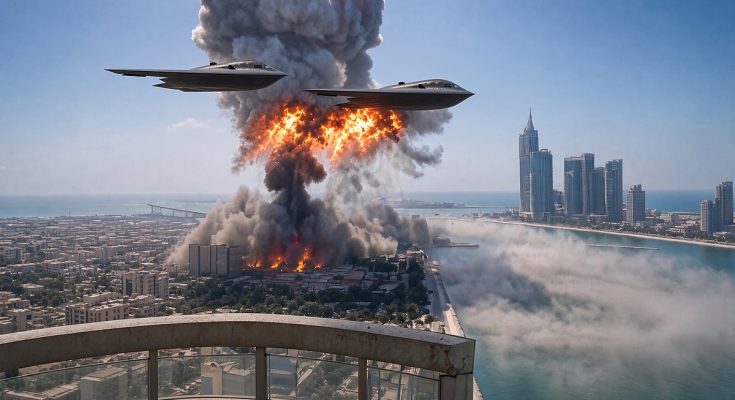
PERSIAN GULF – Tensions across the Persian Gulf have intensified as Iran has launched missile and drone attacks against locations hosting U.S. military forces, prompting air-defense responses, emergency alerts and precautionary measures in several Gulf states. The attacks come amid the wider U.S.-Iran conflict, which has repeatedly spilled beyond Iran’s borders and placed American military facilities across the region on heightened alert.
The latest escalation has increased concerns that the conflict could develop into a broader regional confrontation, particularly because U.S. forces are stationed at military installations across several Gulf countries. These facilities play an important role in American military operations and regional security arrangements, making them potential targets during periods of heightened tension between Washington and Tehran.
Iran’s use of missiles and drones presents a significant challenge for regional air-defense systems. While modern defense networks can detect and intercept many incoming threats, attacks involving multiple drones or missiles can place additional pressure on those systems. Governments in the region have therefore taken precautionary steps, including issuing emergency warnings, increasing military readiness and advising residents in affected areas to remain alert.
The attacks have also raised concerns about the safety of civilians living near military installations. Many American bases are located close to major population centers, airports, ports and critical infrastructure. Any attack that strikes a military facility could therefore have consequences extending beyond the intended target, particularly if debris, explosions or secondary damage affects nearby civilian areas.
The Persian Gulf occupies a strategically important position in the global economy. The region is home to some of the world’s largest oil and natural gas producers and includes vital shipping routes through which significant quantities of energy supplies are transported. Continued military escalation could therefore create uncertainty in global energy markets and increase concerns about disruptions to commercial shipping.
The Strait of Hormuz is particularly important in this context. The narrow waterway connects the Persian Gulf with the Gulf of Oman and the wider Arabian Sea and is one of the world’s most strategically significant maritime routes. Any prolonged military confrontation that threatens shipping through the strait could have consequences well beyond the Middle East, potentially affecting energy prices, transportation costs and international trade.
Gulf governments are also closely monitoring the possibility that attacks could expand beyond military targets. Previous periods of regional tension have demonstrated that conflicts involving Iran, the United States and their respective allies can involve drones, missiles, cyber operations and attacks on infrastructure. Oil facilities, airports, ports and other strategic locations could become vulnerable if hostilities continue to expand.
The escalation is also placing pressure on governments that host U.S. forces. Countries such as Bahrain, Qatar, Kuwait, the United Arab Emirates and Saudi Arabia have important security relationships with Washington, while simultaneously seeking to avoid becoming direct participants in conflicts between the United States and Iran. Their governments must therefore balance military cooperation with efforts to protect their populations and territory from possible retaliation.
For the United States, the presence of military personnel and infrastructure across the region provides strategic advantages but also creates vulnerabilities during a direct confrontation with Iran. American forces can use regional bases to monitor developments, support military operations and protect shipping routes, but those same facilities can become targets for Iranian missiles and drones.
Iran, meanwhile, has repeatedly demonstrated its ability to use long-range missiles and unmanned aerial systems as instruments of military pressure. The use of drones can provide Tehran with a relatively inexpensive means of threatening distant targets, while ballistic and cruise missiles can pose more immediate and destructive risks. The combination of different types of weapons can complicate defensive efforts and force opposing forces to maintain a high state of readiness.
The immediate priority for governments across the region is preventing further escalation. Emergency measures and air-defense deployments can reduce the risk posed by incoming attacks, but they cannot eliminate the possibility of miscalculation. A missile interception, accidental strike or attack causing significant civilian casualties could trigger another round of military action and make diplomatic de-escalation more difficult.
The broader conflict also has implications for international diplomacy. European governments and other major powers face pressure to encourage restraint while attempting to protect their citizens, commercial interests and energy supplies in the region. Diplomatic channels may become increasingly important if military exchanges continue, particularly if either side seeks a temporary pause or negotiations aimed at preventing the conflict from spreading.
For residents of Gulf countries, the immediate consequences are likely to include heightened security measures, possible disruptions to air travel and increased public anxiety. Authorities may issue emergency alerts or temporarily restrict access to sensitive areas depending on the location and scale of attacks.
The situation remains highly fluid. Further missile or drone launches, additional military responses or attacks on critical infrastructure could rapidly change the security environment across the Persian Gulf. At the same time, diplomatic intervention could potentially prevent the current escalation from developing into a wider regional conflict.
For now, the latest attacks underline the vulnerability of the Gulf to the consequences of the U.S.-Iran confrontation. What began as a conflict centered primarily on the two countries has the potential to affect neighboring states, international military forces, global energy markets and commercial shipping. The coming days will therefore be closely watched by governments and markets around the world as they assess whether the confrontation remains limited or develops into a significantly broader regional crisis.