
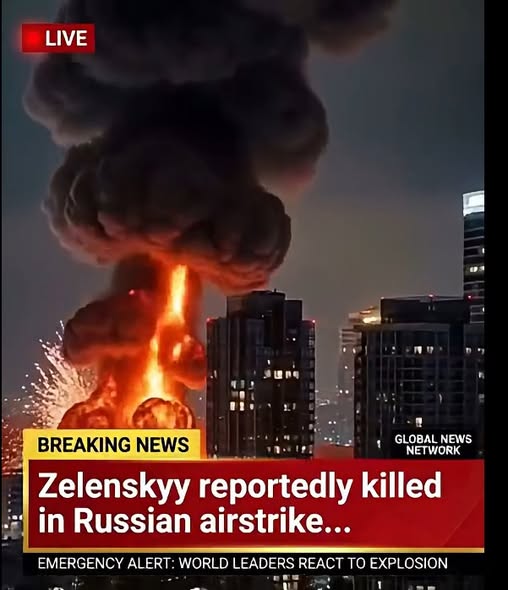
Russia launched another wave of drone and missile strikes across Ukraine overnight, targeting multiple regions as the war continues to intensify. According to Ukrainian officials, the attacks caused significant damage to civilian infrastructure, including residential buildings, power facilities, and public infrastructure. Air raid sirens sounded in several cities as Ukrainian air defense systems attempted to intercept incoming drones and missiles.
Emergency officials reported explosions in multiple urban areas, prompting firefighters, rescue crews, and medical teams to respond to damaged sites. Authorities said they worked through the night to extinguish fires, assist injured civilians, and assess the extent of the destruction. Residents in affected regions were urged to remain in shelters and follow official safety instructions amid concerns that additional strikes could follow.
At the same time, unverified claims have circulated widely on social media and other unofficial platforms alleging that a Russian strike hit a secure location in Ukraine and killed President Volodymyr Zelenskyy. Some posts also claim that Ukrainian media outlets are reporting the incident.
As of this writing, there is no official confirmation from the Ukrainian government that President Zelenskyy has been killed. Likewise, no credible international news organizations have verified the claim. In conflict situations, false or misleading reports often spread rapidly online, particularly regarding high-profile political leaders and major military developments.
Why Reports of Volodymyr Zelenskyy’s Death Should Be Treated With Caution
Military analysts and independent observers continue to urge caution when evaluating dramatic claims emerging from an active war zone, particularly when those claims involve the death or disappearance of a major political leader. In the case of reports alleging that Ukrainian President Volodymyr Zelenskyy has died, the distinction between a confirmed event and an unverified claim is especially important. Until Ukrainian authorities or multiple reliable and independent news organizations provide clear confirmation based on credible evidence, such reports should be treated as unverified and should not be presented to the public as established fact.
Modern warfare is no longer fought exclusively on battlefields. Information itself has become an important part of conflict. Governments, military organizations, political groups, activists, anonymous accounts, influencers, and ordinary users can all publish information online within seconds. A dramatic claim can spread across multiple platforms before journalists have had enough time to establish where it originated, whether the material is authentic, and whether independent evidence exists to support it.
This creates a particularly difficult environment for anyone attempting to understand breaking developments.
A claim that appears in thousands of posts is not necessarily a claim that has been independently confirmed thousands of times. In many cases, hundreds or even thousands of accounts may simply be repeating the same original allegation. Once copied and reposted repeatedly, an unverified statement can begin to look like established information even when no new evidence has emerged.
That phenomenon is particularly dangerous when the claim involves the death of a national leader.
Such an announcement would have enormous political, military, and international consequences. It could affect financial markets, military decision-making, diplomatic relations, public confidence, and the behavior of armed forces. Because the potential consequences are so significant, responsible reporting requires a much higher standard of verification than simply pointing to social-media posts or anonymous online sources.
Military analysts therefore emphasize the importance of separating information into different categories.
There is credible but still developing information.
There are reports that remain under investigation.
And then there are claims for which there is currently insufficient evidence.
The last category should not be quietly transformed into the first simply because the allegation is dramatic or because it has generated enormous attention online.
The speed of social media has made this distinction more difficult than ever.
A single post can be published from anywhere in the world. It can include photographs, videos, screenshots, supposed documents, or statements attributed to unnamed officials. Within minutes, other users can copy the material and present it without the original context.
Others may contain old material presented as new.
Some may use authentic photographs but attach a false explanation.
And some may begin as speculation before being transformed into apparently authoritative “reports” through repeated reposting.
This is why experts frequently recommend asking a basic question: Where did the information originally come from?
If a major claim can be traced back to one anonymous account, one unexplained screenshot, or one website that provides no verifiable evidence, it should not automatically be treated as confirmed simply because other accounts are repeating it.
The next question is whether independent sources have verified the same event.
Ten websites repeating the same statement from one social-media account do not necessarily represent ten independent confirmations. Genuine corroboration requires separate sources obtaining information through their own reporting, official statements, direct observation, or independently verified evidence.
For an event as consequential as the alleged death of a sitting president, responsible journalists would normally seek multiple forms of confirmation.
That could include official statements, statements from government institutions, direct reporting by established news organizations, verified appearances or communications, credible diplomatic sources, and other evidence that can be independently examined.
The absence of confirmation does not automatically prove that a claim is false.
But it does mean that the claim should remain classified as unverified.
That distinction is fundamental to responsible journalism.
It is also important to understand that uncertainty during a conflict is not unusual.
War creates an environment in which communication can be disrupted, information can be deliberately concealed, and events can unfold faster than journalists can verify them. Governments may delay announcements for security reasons. Military officials may not immediately have complete information. Communications infrastructure can be damaged or interrupted.
This means that there can sometimes be a genuine period of uncertainty.
However, uncertainty should not be filled with speculation presented as fact.
The temptation to publish first can be extremely powerful, particularly in a competitive digital media environment. News organizations and social-media creators know that dramatic stories generate clicks, shares, comments, and attention. A headline claiming that a major world leader has died is almost guaranteed to attract enormous interest.
But speed should never replace verification.
The consequences of getting such a story wrong can be enormous.
A false report about the death of a president could trigger panic among civilians, confusion among military personnel, political instability, financial volatility, and a flood of additional misinformation. It could also make it harder for the public to distinguish legitimate information from propaganda.
This is precisely why military analysts often describe information warfare as a battlefield of its own.
In modern conflicts, controlling the narrative can influence morale just as much as controlling physical territory.
False reports about political leaders can be designed to create uncertainty among citizens.
They can be intended to damage confidence in government institutions.
They can attempt to influence soldiers’ morale.
They can encourage supporters to believe that a conflict is approaching a decisive turning point.
They can also be used to provoke emotional reactions among audiences far away from the battlefield.
The most effective misinformation does not necessarily look obviously false.
Sometimes it is built around a small amount of genuine information.
A real photograph may be combined with a false caption.
An old video may be presented as footage from a recent event.
A genuine statement may be removed from its original context.
A real news report may be deliberately misinterpreted.
These techniques make verification essential.
Images and videos should therefore be examined carefully before being treated as evidence.
When was the material originally created?
Do buildings, vehicles, signs, uniforms, or other details correspond with the location?
Has the material appeared online previously?
Can the source of the original file be identified?
These questions may sound technical, but they are increasingly important in the modern information environment.
Artificial intelligence and increasingly sophisticated editing tools have also made it easier to create convincing fake audio, images, and video. A recording that appears to show a public official making a statement may not necessarily be authentic.
It means that extraordinary claims require appropriate verification.
The same principle applies to supposed official documents.
A screenshot displaying a government logo or an apparent announcement does not automatically prove that the document is genuine. Official communications should be checked against recognized government channels and reputable reporting organizations whenever possible.
For the public, one of the simplest and most effective safeguards is to slow down.
If a shocking claim appears on a social-media feed, there is no obligation to immediately share it.
Waiting for additional information is not the same as ignoring an important event.
In fact, waiting can be one of the most responsible things a person does.
People should be especially cautious when a post uses language such as “breaking,” “confirmed,” “sources say,” or “the world is in shock” without identifying credible sources. Emotional language is often designed to encourage immediate reactions before readers have time to evaluate the evidence.
A responsible approach is to ask whether the claim has been reported by established, independent organizations with a history of verifying major international events.
If it has not, the safest description is simple:
Calling an unverified death report a “confirmed death” transforms uncertainty into fact. Once that happens, later corrections may not undo the damage. People who saw the original claim may never see the correction.
This is one reason misinformation can be so difficult to reverse.
False information often travels faster than corrections.
A dramatic claim may be shared thousands of times within minutes, while a later clarification may receive only a fraction of the attention.
The problem becomes even more complicated when users encounter multiple versions of the same story.
Another claims the leader has disappeared.
Another says the government is hiding the truth.
Another claims to have exclusive footage.
The sheer number of competing claims can create the illusion that something significant must have happened.
But conflicting claims do not constitute confirmation.
That is why professional journalists and analysts rely on verification rather than volume.
The situation involving claims about Zelenskyy’s alleged death is therefore a useful example of a broader challenge facing audiences everywhere.
People are living through an era in which information is available almost instantly, but reliable information still requires time.
The internet has made it possible to know about events on the other side of the world within seconds.
It has not made verification instantaneous.
A responsible news consumer should be willing to tolerate uncertainty.
Sometimes the most accurate answer is simply: We do not know yet.
That may feel unsatisfying, especially when an extraordinary story is circulating everywhere, but acknowledging uncertainty is far more responsible than inventing certainty.
It is also important to remember that official confirmation should come from legitimate channels.
For a major event involving Ukraine’s leadership, statements from recognized Ukrainian government institutions and established diplomatic or governmental sources would carry substantially more weight than anonymous social-media accounts.
Independent reporting is equally important because multiple credible organizations reaching the same conclusion through separate verification can provide stronger corroboration than a single source.
Ultimately, the responsibility does not belong only to journalists.
Ordinary social-media users also play a role.
Every time someone shares an unverified claim, they potentially become another link in the information chain.
Every time someone pauses and asks whether a story has actually been confirmed, they interrupt that chain.
The difference may seem small, but when millions of people are consuming information during a crisis, those individual decisions can have significant consequences.
The war in Ukraine has already demonstrated how quickly information can become part of the conflict itself. Narratives about battlefield developments, military losses, political decisions, leadership changes, and alleged attacks can spread across the world long before the underlying facts are fully established.
That makes media literacy increasingly important.
People need to understand the difference between evidence and assertion.
They need to recognize that popularity is not proof.
They need to understand that repetition is not independent confirmation.
And they need to recognize that a screenshot, anonymous source, or dramatic video is not automatically reliable evidence.
For now, any report alleging that President Volodymyr Zelenskyy has died should therefore be approached with extreme caution unless and until it is confirmed by credible Ukrainian authorities and corroborated by multiple reliable, independent sources.
The responsible position is not to dismiss every report automatically.
Nor is it to believe every report immediately.
It is to remain skeptical until the evidence becomes strong enough to justify confidence.
In an age when misinformation can cross borders in seconds, caution is not weakness.
And when the claim concerns the death of a national leader during an ongoing war, that responsibility becomes even more important.
Until credible confirmation emerges, the allegation remains exactly that: an allegation.
And certainly not something that should be presented to millions of readers as truth simply because it is circulating widely online.